Skip to content
Archive of entries posted on December 2010

Union Station Update #47

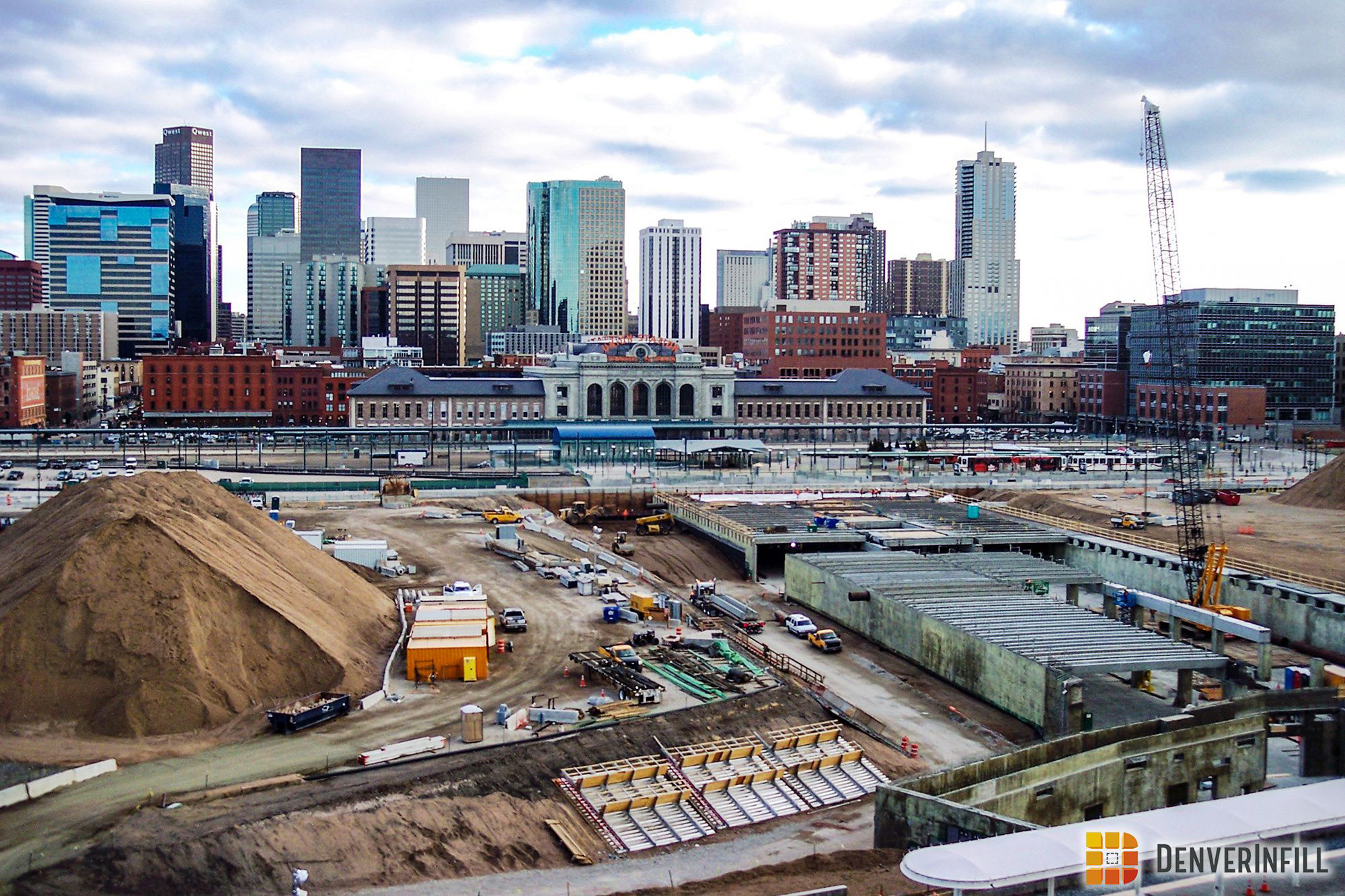
What’s a train station without railroad tracks?  A bus stop!  But we already have a big one of those in the works so let’s make a real train station.  Check.

The first photo above shows some of the first railroad ties being installed at the light rail station on Friday morning … six ties at a time.  Each concrete tie weighs 550 pounds so it seems like quite a load for that little excavator.  The second photo shows progress as of late Saturday afternoon.  Presto, it looks like a train station.

A new phase of the bus terminal was also taking shape on Friday.  As you can see below, the first batch of concrete was poured on the roof of the terminal.

The photo is a bit snowy, literally.


Union Station Update #46

I have updates on several fronts today.

Kiewit has started the process of laying tracks at the light rail station.  Recently, hundreds of railroad ties were delivered over the past few days and are staged on site.  This morning, rails have been moved from the staging area.  Using a specialized machine, the ties will be set six at a time.  I’ll show off my new vocabulary: Once the ties are in place, crews will begin “stringing the track” and will use “E-clips” to fasten the tracks to the ties.  After the tracks are strung, a “tamper” will shake the track and ties to hasten their settlement into the “ballast” (big rocks) which has been spread over the top of the “sub-ballast” (small rocks).  Keep tuned in to DenverInfill for the first photos of the new tracks.  In the meantime, here’s a shot of the staged ties and the groomed ballast.

As Chachafish pointed out in his or her comment on Update #45, the fabric was installed late last week over the light rail canopy frame.  It looks pretty sharp.  Here is a photo of the finished product.

If you have spent some time lurking under the Millennium Bridge, you probably noticed that a transformer blocks the right of way between the current light rail tracks and the new station.   That transformer, which powers the light rail, will be moved three months prior to the cutover to the new light rail station so the tracks can continue on their way under the bridge.

Tracks at the temporary Amtrak station will be laid in January shortly before the station becomes operational on February 1.  The certificate of occupancy for the station was issued on Monday.

As you can see in the photo below, construction of the bus terminal roof has resumed.  More beams are being installed and preparation is also underway to pour concrete over the first portion of the roof.  Pouring concrete on a roof is especially tricky this time of year.  Workers will probably have to heat it from below so it dries properly.  As Bostonians know from a Big Dig failure, it’s not a good idea to have faulty concrete on a roof.

The dewatering system is being downsized now that the bus terminal floor is completed, the walls are nearly done, and the water table is seasonally low.  Before digging starts on the second half of the terminal, new wells will be drilled along its eventual perimeter between Wewatta Street and Union Station, and the dewatering system will be reinstalled to keep the new digging location dry.  You can see before and after photos of the dewatering system at Jobsite Visitor.com.  Go to the “Plan View” tab, find the appropriate camera angle, and click through various weeks to see changes.  By the way, you can use that section of the website to see weekly changes of the project from the nine camera locations that are shown along the freight tracks.

A few days ago, backfilling along the 18th Street side of the bus terminal began.  Here’s a photo of the progress.

We should start saying our good-byes to the Union Station tunnel.  It will be gone in late-winter or early spring.  To me, the loss of the tunnel is the only real downside of this fabulous project.  I use it as an oasis from the cold in the winter and from the sun in the summer.  I soak up its history several times a week.  My dad walked through that tunnel during an overnight stop in Denver in 1946 on his way home from the Pacific Theater to Western New York after his 4-year stint in the Marine Corps.  For six decades, I listened to his fond stories of his short stay in Denver.  There wasn’t much to say, but it was important enough for him to say it many times.  He died last year at 92.  Thousands of others made the walk through that tunnel.  For many, it was one-way.

I have posted 13 new photos, including the ones in this blog, on our Denver Union Station page at JobSiteVistor.com.


Next Union Station Tour Is January 15, 2011

DenverInfill is taking a holiday break from our regular Union Station Tour schedule. There will be no tour offered this Saturday, December, 18.

Also, although our schedule is to conduct tours on the first and third Saturdays of each month, we will also skip (for obvious reasons) the first Saturday of January 2011, New Year’s Day.

Please plan to join us then on Saturday, January 15, 2011 for our next Union Station tour. I’ll post a reminder blog here at DenverInfill as that date approaches.


Better Denver Bond Projects at DenverUrbanism

In case you’re not visiting our companion blog DenverUrbanism as frequently as you should be, please check out our new series summarizing a few of the better Better Denver Bond projects, including this first one on what’s planned for Broadway and Colfax.


Auraria Update: Hotel & Hospitality Learning Center

The Metro State Hotel & Hospitality Learning Center on the Auraria Campus will break ground February 2011.

The proposed combination hotel/academic building is planned for the corner of Auraria Parkway and 12th Street where tennis courts are currently located. Here’s the site from Google Earth:

2010-12-15_hlc_aerial

The hotel portion will be branded as a Marriott SpringHill Suites and will contain 150 rooms, a conference facility with a 350-person capacity, and a fast-casual restaurant franchise. The hotel will be managed by Denver’s Sage Hospitality. The academic portion will include over 21,000 square feet of classrooms, laboratories, and faculty offices for Metro State’s Hospitality, Tourism & Events program.

Here are three images of the project, courtesy of RNL Design:

View of the northeastern side. The intersection in the foreground is eastbound Auraria Parkway (wide street in front) and 12th Street (narrow street heading off to the left):

2010-12-15_hlc

View of the southeastern side facing the athletic fields and Lawrence Street:

2010-12-15_hlc2

Internal courtyard:

2010-12-15_hlc3

If all goes as planned, the facility will open September 2012.


Down by the River

Did you know the South Platte River is getting a makeover in a tucked-away industrial stretch south of Mile High Stadium? It may not be as visible as the big Union Station project just a bit to the north, but the Platte River project, along with a couple of other major infrastructure investments in the vicinity, will transform the way people and water flow through the southwestern corner of the Downtown Denver area.

A total of three infrastructure projects are underway in the area around the Xcel Energy Zuni Plant south of the stadium, so in case you weren’t aware of what’s going on down by the mighty Platte, I’m happy to provide you with this overview. The three projects are: Floodplain and bank improvements to the South Platte and Lakewood Gulch, RTD’s West Corridor Light Rail project, and the reconstruction of the Federal Boulevard bridge over Lakewood Gulch. The projects are being coordinated in a good example of several government and utility entities and private contractors all working together.

South Platte River/Lakewood Gulch: You may have heard the old saying that when Denver was first founded, the settlers described the South Platte River as “an inch deep and a mile wide”. That wasn’t much of an exaggeration. The Platte has been prone to frequent flooding, as several great floods in the city’s history demonstrate. When the Central Platte Valley area west of Downtown was planned for redevelopment in the 1980s, fixing the flooding issues was a necessary component to the area’s redevelopment. The first flood control project was completed in 1995 on the stretch of the Platte between Cherry Creek and I-25. The second project was completed in 2001 between I-25 and Lakewood Gulch, and now the third and final stretch, from Lakewood Gulch to approximately 8th Avenue, is underway. The current project will finally remove most of the areas west of Downtown from the 100-year floodplain, and is being directed by the Urban Drainage & Flood Control District (UDFCD), which was formed in 1969 to oversee waterways and flood control in the Denver Metropolitan area.

The South Platte River/Lakewood Gulch project is widening the Platte River between Lakewood Gulch and 8th Avenue by about 40 feet on average (roughly 20 feet on each side) as well as lowering the river bed by about 5 feet. Doing so greatly increases the river channel’s capacity during heavy rain events, thereby decreasing the potential for flooding. Here’s a photo of this stretch of the Platte (courtesy of the UDFCD):

2010-12-12_platte1

As part of the river project, the multi-use trail system along the river will be completely rebuilt and expanded, a grade separated trail crossing under 13th Ave will be installed, three drop structures (think: mini-waterfalls) will be built in the river to allow for flatter channel slopes, and the river banks will be restored with native vegetation. Here are some photos I took a few weeks ago of the river-widening/deepening effort:

2010-12-12_platte2 2010-12-12_platte3

The other part of this project is improvements to Lakewood Gulch. Lakewood Gulch flows east-west roughly along where W. 13th Avenue would be. West of Federal, it’s a wide landscaped corridor maintained by Denver Parks & Recreation as Lakewood Gulch Park and Sanchez Park. East of Federal, it flows along the northern edge of Rude Park up to Decatur Street, where it’s then squeezed into a narrow ditch sandwiched between industrial buildings and parking lots for the final 1,000 feet until it joins the Platte River. Here’s a satellite photo from GoogleEarth and another aerial from the UDFCD:

2010-12-12_platte5 2010-12-12_platte4

This final stretch of Lakewood Gulch will become a wide landscaped area similar to the Lakewood Gulch Park west of Federal. The large rectangular warehouse building is the City’s Decatur Shops Building. Its functions are being relocated and the building and its parking lots are being demolished. Lakewood Gulch will be realigned and widened through the site, with multi-use trails, a pedestrian bridge, and native vegetation added along the way. Here’s a diagram, courtesy of Matrix Design Group (my employer, who was hired to do the engineering design for the project). Also, a big thank you to my coworker Kyle for his helping me with information and a tour of the project.

2010-12-12_platte0

RTD West Corridor Light Rail: Running through the middle of the Lakewood Gulch project is RTD’s West Corridor Light Rail line currently under construction. The Federal-Decatur Station will be located on the triangle parcel of land north of Rude Park. The flood control improvements described above will also remove RTD’s light rail line from the floodplain. The transit line will cross at-grade over Decatur Street, span the newly aligned Lakewood Gulch on a new bridge, before crossing over the Platte River. The light rail bridge over Lakewood Gulch is being built first (it’s visible in the GoogleEarth photo above) and then the new gulch will be dug underneath it. Here are two photos I took, the first one looking straight east down the light rail path with the Lakewood Gulch bridge in the foreground and the arched spans of the bridge over the Platte in the background. The second photo shows a side view of the new light rail bridge over the Platte:

2010-12-12_platte6 2010-12-12_platte7

New Federal Boulevard Bridge over Lakewood Gulch: The final project is the new Federal bridge over Lakewood Gulch. The existing CDOT bridge was in poor condition but its reconstruction also accommodates the RTD tracks and the reconfigured Lakewood Gulch below. Here’s another UDFCD photo from this summer showing the western half of the new bridge under construction, followed by a photo from me a few weeks ago with the new western half open to traffic and work starting on the eastern half.

2010-12-12_platte8 2010-12-12_platte9

There’s actually a fourth project in this area… just to the north, CDOT is getting started on rebuilding I-25 over the Platte River. If you’ve ever walked from the Invesco Field light rail station to Mile High Stadium, you’ve walked under the I-25 bridge over the Platte. That’s a two-year project that is sure to make a mess of traffic, but it’s one of the poorest-rated bridges in Colorado, so it’s good to see its reconstruction happening.

Lots of great infrastructure projects going on in Denver!