Skip to content
Archive of posts filed under the Urban Design category.

Welcome Arch Party Update

Due to a potential conflict with the Rockies’ playoffs, the big Union Station party to raise money for the Welcome Arch has been moved to Wednesday, November 11. Have you bought your tickets yet? This is going to be a great evening for a great cause… I hope you’ll be there! All the details are below:

Union Station Welcome Arch Returns!

Union Station Advocates has launched a campaign to bring back the Welcome Arch to Union Station, and will be holding a big gala in Union Station in October as the kickoff fundraiser event.

This is going to be Downtown’s biggest social event of the season and a great way to help contribute to the Union Station project as construction gets underday. Don’t miss it! Go to www.blacktie-colorado.com to RSVP. Enter event code: USA 10/15. Tickets start at $40.

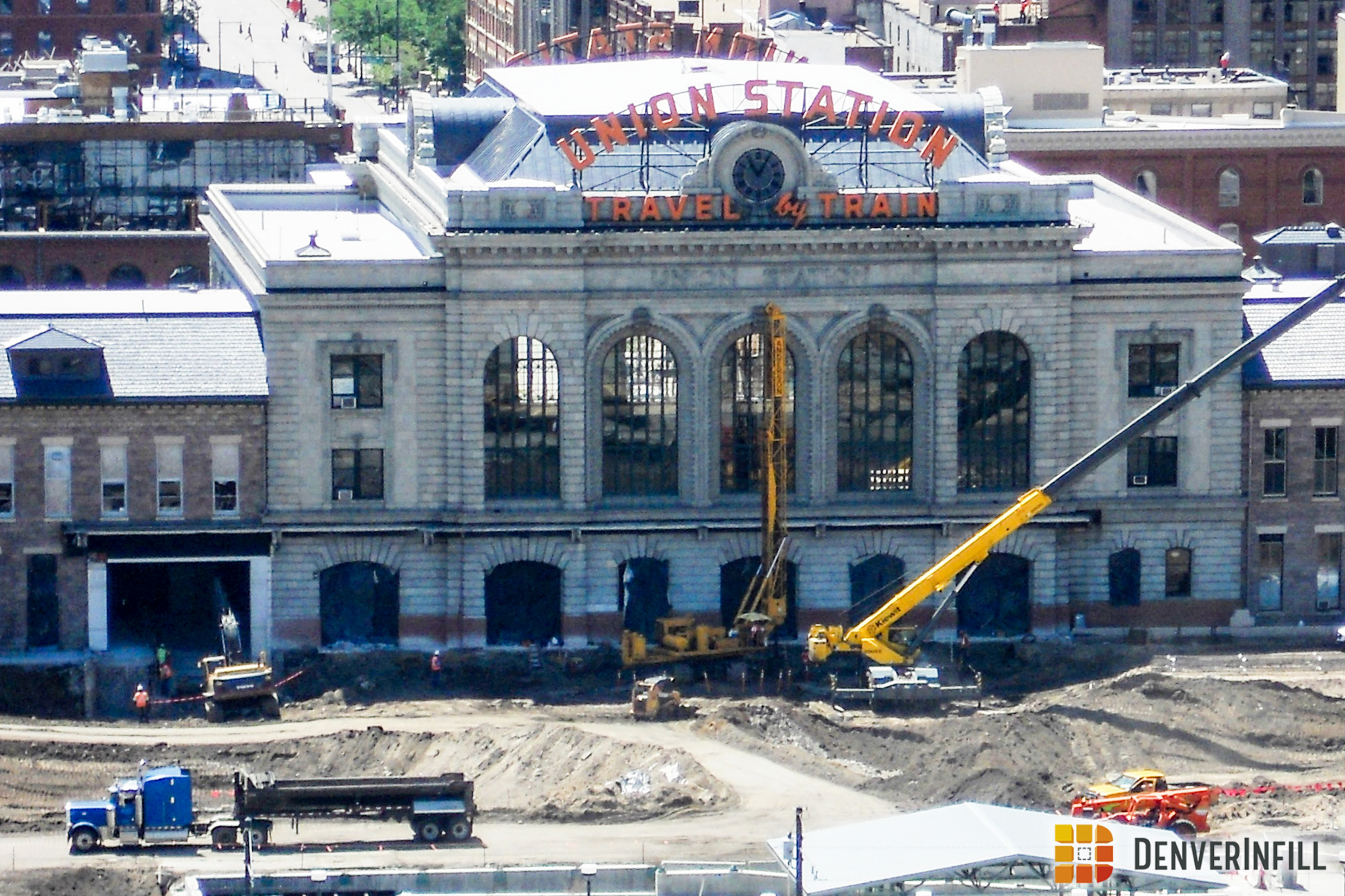
Will the new Welcome Arch be a faithful historic replica or a modern interpretation of the original? While it is certain the new Welcome Arch won’t be placed in its original location at 17th and Wynkoop, there are several interesting possibilities for its placement within the Union Station Transit District site. The preferred location and Arch renderings may be released soon.

Denver Justice Center Update

Denver’s $350 million new Justice Center is now in its final year of construction. The Detention Facility is supposed to open Spring 2010, and the Courthouse later that summer. With most of the exterior now complete, one can finally start to get a sense for how well the buildings fit in their place in the city and how they engage the emotions (or not).

First, some photos (thanks again to Vicki), starting with the Detention Facility. From left to right: northeast corner, northwest corner, southwest corner, southeast corner.

2009-08-25_jail1 2009-08-25_jail2 2009-08-25_jail3 2009-08-25_jail4

I’m picking up a slight Art Deco vibe from this building. Maybe it’s the exterior color and materials or something, but it sort of reminds me of an oversized modern second cousin to the Boulder County Courthouse. For a jail, and considering it’s not finished yet, I’m thinking this building may be OK.

Next, the Courthouse. From left to right: northeast corner, northwest corner, southwest corner, southeast corner.

2009-08-25_courthouse1 2009-08-25_courthouse2 2009-08-25_courthouse3 2009-08-25_courthouse4

To me, this building gives off little hints of International Style. I see similarities between this building and the base of the Wellington Webb building (both Tryba’s addition and the historic Annex portion along Colfax). I’m still not particularly fond of the glassy Jury Assembly Room that juts out into the plaza, but I do like overall the dramatic glass curtain wall on the main structure. I think both buildings will look quite nice in the evening, assuming the city plans to install appropriate accent lighting on each structure.

The plaza planned for in between these two buildings hasn’t been installed yet so it’s too early to pass judgement, but it seems to me that the buildings are too far apart from each other and that the plaza will feel a little too exposed, but we’ll see.

Paris Observations, Part 2

Another aspect of the scale of cities that was illuminated to me by my recent trip to Paris is the issue of skyscrapers—or lack thereof—and the vitality of the city. One of the interesting debates that goes on in the comments to this blog, as well as in any urban/architecture/planning-type forum or website, is the matter of density and how it is best distributed across the urban core.

There are some people that want every new building in Downtown Denver to be the tallest it can be, even if it is at the expense of other new infill projects. One 50-story building, they say, is better than five 10-story buildings and certainly better than 10 five-story buildings. The appeal of skyscrapers is strong. As soaring works of engineering and (sometimes) art, they capture our imagination and represent a dramatic example of the prowess and progress of our species. For many people, the skyscraper is what it is all about.

There are other people, however, who believe that the best way to make a great urban environment is the “spread it around” alternative—in other words, assuming a sufficient supply of vacant land, 10 five-story buildings are preferable to a single 50-story skyscraper (as long as the ground floors are engaging, etc.). Philosophically, I support this view over the “skyscraper” approach, although I’ve certainly cheered virtually every new high-rise proposed in Denver. Generally I’m not about to openly denounce a 40-story building proposed for Downtown Denver if a developer is willing and able to build one.

But, in the end, it really comes down to this: What will give Downtown Denver the best urban environment? To me, it begins with a horizontal intensity of pedestrian-scaled, mixed-use buildings, supported by exceptional public transportation and a well-designed and maintained public realm. If we had a steady, sustainable demand here in Denver for the square footage of uses that require skyscraper development, I’d say let’s reach for the sky. But, in reality, the demand for that kind of density in Downtown Denver evolves at a relatively slow pace. Therefore, if the market demand supports the equivalent of only a few skyscrapers per decade, then I would prefer that that demand be met through multiple mid-rise buildings instead. We have hundreds of vacant parcels and surface parking lots in our urban core. If we hold out (as many property owners do) for a skyscraper on every vacant lot, then it will take decades—many of them—before our undeveloped Downtown land is replaced with vibrant urban uses. In the meantime, the remaining vacant parcels perpetuate a stagnant, anti-urban influence to the detriment of Downtown. I prefer that we achieve a great street-level urban environment sooner rather than later by replacing as many empty lots as possible, and worry about adding a “new tallest” to our skyline in the future. I’ll take five 10-story buildings over a single 50-story building any day.

Paris is the perfect example of this approach. About three million people live within a three-mile radius of Notre Dame with hardly a skyscraper in sight; yet, the environment is intensely urban and as thriving as can be imagined. That would be like putting the entire population of the Denver-Aurora-Boulder CSA inside the area bounded by Sheridan Boulevard, Colorado Boulevard, Interstate 70, and Mississippi Avenue, with virtually no high-rises.

As you know, this is the typical density of Paris:


How do we achieve this in Denver’s urban core? One approach would be to downzone the urban core. Yes, I said the “d” word. If dozens of vacant or underdeveloped parcels in Downtown Denver currently have zoning on them that allows for 50-story (or higher) towers, then few property owners will want to sell their vacant land for a price that is anything less than a value commensurate to the development of a 50-story project. That’s one reason why we have so many holdouts: landowners who are waiting for the once-in-a-lifetime opportunity to strike it rich by selling their crappy parking lot to Donald Trump for his next mega-tower. Meanwhile, generations go by while Downtown Denver suffers all those crappy parking lots. A reasonable downzoning in conjunction with a Transfer of Development Rights (TDR) program would ensure that the property owners don’t lose the economic value of their land under the existing zoning, while providing parcels to the market at land values that actually pencil out for mid-rise projects.

Another approach would be to change our property tax structure for Downtown Denver. Currently, property in Denver is taxed on the value of the land and improvements (i.e. buildings) with the emphasis on the improvements. But a surface parking lot? Not much “improvement” value there. Consequently, relatively low property taxes on vacant parcels discourage their development. But, if we adopted a Land Value Tax approach for Downtown Denver, we’d incentivize property owners to develop their land or sell it to someone who would, and discourage land-banking and speculation. The Land Value Tax approach has worked well in the cities that have tried it, such as Harrisburg, Pennsylvania, where significant infill development has occurred in their downtown since implementing the LVT.

Skyscrapers are cool, but I would prefer Downtown Denver to become more like Paris than New York City. Maybe once we’ve covered 100% of our urban core with buildings and bustling streets, we can justify taking it to the next level. But for now, the best thing we can do for Denver is to achieve Mayor Speer’s vision of a “Paris on the Platte”.

Final 18th Street Ped Bridge Rendering

You may recall a few weeks ago I mentioned that the 18th Street Pedestrian Bridge is now under construction in the Central Platte Valley. Chad at OZ Architecture, who designed the new bridge, was kind enough to send me a rendering of the bridge’s final design. Back in May 2007 I posted some early design renderings of the bridge.

Here’s what is being built:

The bridge design features switch-back stairs and elevators at each end, and some high quality materials, such as elevator components clad in copper. The bridge will also have some nighttime illumination. Of course, this bridge is not meant to compete with the iconic Millennium Bridge, but it still looks pretty nice to me.

Next up: construction of the relocated Union Station light rail platform should begin this summer. The extended end of that platform will tie in with the base of this new 18th Street pedestrian bridge.

Paris Observations, Part 1

I’m back! I hope you’ll forgive me for the dearth of posts lately, but the past six weeks have been crazy with a bunch of work and other professional events and trips one right after another, followed immediately by a 15-day vacation in Europe. My travels took me to Paris, Amsterdam, and a few other cities in the Netherlands. Of course, I can’t wander around cities like those (or any city for that matter) without viewing my surroundings through an urban planning and development prism. So as usual, I’ll share with you my observations (and a few photos) of these cities and maybe how Denver could improve from being a bit more like them.

Let’s start with Paris. Wow. Where to begin? What an incredible city! I can see why many people consider Paris to be the grandest city in the world. The combination of a built environment so perfectly suited to the pedestrian, public transit that can take you anywhere with ease, an intense and fine-grained mix of uses, a ubiquitous spirit of history and culture, and a mass of humanity energized by all of the above… is a combination that makes for an exceptional urban place. The French are known for their cooking. I’d say they have the recipe for a city down perfect.

For this Part 1 of my observations of Paris, I’ll focus on the organization of space. What struck me about Paris is that it’s a city scaled around two extremes: the monumental and the intimate. There are dozens of buildings in Paris that can only be described as monumental. In American cities, we typically achieve monumentality by going vertical (in the form of skyscrapers); in Paris they achieve monumental buildings by going horizontal. A 1000-foot-long building in the middle of the city? In the US, we may look negatively on such a building, saying that it creates a “superblock”. In Paris, it seems to work just fine. In part, it is because those monumental Parisian buildings are usually organized around monumental public spaces that not only give one room enough to comprehend and appreciate the monumental scale of the building, but also room for some relief from it. Fifty-acre parks and half-mile-long plazas sprinkled throughout the Parisian urban core create open spaces that are both a luxury and a necessity and the perfect complement to the city’s monumental buildings.


On the other side of the spatial coin are the city’s thousands of buildings and spaces that exist at an intimate scale. The typical Parisian building can’t be more than 20 or 30 feet wide, with each offering a cozy space internally and a unique facade and storefront externally. Stitch all those narrow buildings together and you get two things: solid blocks of buildings that form the walls that enclose the streets, sidewalks, parks, plazas, and courtyards of the public realm; and a street wall with a pattern and rhythm to it that is cohesive but distinct, predictable but interesting, and engageable only at a pedestrian pace. The narrowness of so many of the city’s streets make them intimate places too and, therefore, pleasant, even when sharing the space with a crush of cars, bicycles, busses, scooters, and humanity. It seems that every square inch of the public realm in Paris is used in a thoughtful way, resulting in thousands of intimate public spaces. Even the occasional wide spot in the sidewalk or the odd notch out of a building has been outfitted with a tree or a bench or a fountain, making it a small but appreciated place for people to pause.


Finally, there is the ratio between these monumental spaces and these intimate spaces. Too many monumental places would make the city too difficult to traverse by foot, too open and exposed, too intimidating and impersonal. Too few monumental places would make the city too claustrophobic, too monotonous, too uninspiring. But, disperse within a tight fabric of intimate buildings and spaces just the right amount of spatial monumentality, and you get an exceptional urban environment. This is Paris.

Design Element Caps New Parking Garage

Trammell Crow’s 17-story 1900 16th Street office tower in the Union Station district has topped off and is on track for its opening later this year. Included in the project is a parking garage at 15th and Delgany featuring ground-floor retail spaces and a newly installed design element meant to complement the Museum of Contemporary Art building across the street.

Perhaps you noticed in the past couple of weeks large brackets being installed on the garage’s 15th and Delgany corner? Those brackets now support large panels that collectively create a subtle design gesture to the MCA’s strong cubic form. Take a look:

Tryba Architects designed the 1900 16th Street project, including the parking garage design element. I think the silvery panels are a good addition to the corner. What do you think?

More on Writer Square

About three weeks ago I blogged about the planned redo of the plaza areas in Writer Square, which was reported to include a glass pyramid and a moat, of all things. Today I’m happy to be able to post a few more renderings of the proposed design. These images are scans of a handout that was provided to Writer Square residents and business owners at a recent meeting with the developer. All images are copyright DHR Architecture / Blue Architects.

First, here’s the site plan:

In the initial phase, the corner at 16th and Lawrence will be a sunken plaza with a small water feature. Reportedly, the pyramid and underground commercial space for that corner would be a future phase only if the right high-profile retailer was found. The wall that runs along Larimer from the corner at 15th Street that separates the plaza from the sidewalk will be removed. I support that idea as it will improve pedestrian circulation, particularly when the city removes a drive lane from Larimer and consequently widens the sidewalk on the Writer Square side of the block next year. Also to be removed is the large triangular planter at the corner of 16th and Larimer, which should also improve pedestrian movement at that intersection.

The site plan also shows, however, that the pedestrian areas will be barren except for pedestrian lighting. The green trees shown on the site plan are on the landscaped upper level residential patios. There appear to be no trees planned for the public plazas themselves. Here are two images showing the proposed sunken plaza at 16th and Lawrence (left) and the plaza at 15th and Larimer (right):

I don’t know about you, but neither space seems particularly inviting. No seating, no flowers or trees, no public art, no shade. Really, who is going to want to sit on a folding chair and play the guitar in a sun-baked concrete plaza in the middle of the summer? In Downtown, we need more trees, more shady areas to provide shelter and refuse from the sun. What will be removed to make way for this sunken plaza? Mature trees. Also, these two images appear to show that the plaza surface will be–concrete squares? How interesting. Other improvements include updating the retail storefronts and signs, which seem appropriate to me.

Finally, here’s a night-time shot showing proposed new signage at 15th and Lawrence:

The project is supposed to begin later this spring and be finished before the end of the year, and will occur in five stages so that the whole site is not impacted at the same time.

Overall, I’m underwhelmed. I fully support the idea of making improvements to Writer Square in general. The existing plaza surfaces are in poor condition, and a general sprucing up of the pedestrian areas and storefronts is a welcome investment. But getting rid of all seating and landscaping seems unwise to me. Writer Square currently provides a pleasant place to sit and relax for a few minutes, set back a bit from the busy streets that surround it. Under the proposed plan, it looks like it will be not a place to dwell, but simply to pass through. Does that really make for a great public space?

Writer Square Renovation Proposed

Margaret Jackson at the Denver Post recently reported on a planned redo of parts of Writer Square on Block 069. Here’s a link to the article.

The plan calls for the construction of a glass pyramid at 16th and Lawrence that will serve as an entrance, Louvre-style, to a retail or restaurant space below. The plan also includes a moat (!) and a general decluttering of the pedestrian areas of their planters, furniture, and sculptures. The article also included a rendering of the proposed pyramid structure:

First, I must say that this rendering is pretty lame. I certainly couldn’t do any better myself–in fact, not even this good, as artistic renderings are not in my realm of skills–but if I were making public my grand plans for a prominent Downtown Denver space, I’d come up with something better than this. The “pyramid” looks like light beams being cast down from a street lamp.

Nevertheless, it isn’t about the quality of the rendering, it’s about the proposed plan, so let’s talk about that. I’ve always been a bit conflicted over how I feel about Writer Square. On one hand, I find the diagonal cut through the block to be a rather pleasant place. It’s exactly the planters and their overflowing flowers, the sculptures, and the pedestrian furniture to be what I enjoy most about Writer Square. Granted, the sculptures are hardly cutting-edge art, and the whole space has a quaintness to it that seems a bit odd for its urban location, but somehow it still seems to generally work. On the other hand, Writer Square’s edges along Larimer, 15th, and Lawrence are definitely much less successful, and even the interior passage has never been the vibrant, people-gathering place I think most people have hoped it would be.

So, having said all of that, I am initially not opposed to the idea that Writer Square could use some updating. If nothing else, the physical site improvements and storefronts are pushing 30 years old, so some rehabilitation work is necessary, and the willingness of a property owner to make a significant investment in their property is always a positive sign. However, is this the right fix for this site?

Let’s start with the moat. A moat, by definition, is a physical element meant to serve as a barrier. Pedestrian barriers are the last thing we need more of in Downtown Denver. I have a hard time envisioning how a moat in a highly pedestrianized area is going to be a good thing. If the moat is narrow enough to not be a barrier (i.e. you could step over it), then it seems like it will only be a pedestrian hazard. If it’s too wide to cross except for where there are “bridges,” then for six months of the year, the moat will end up being a dry, litter collector. I may be convinced otherwise if I see a detailed plan of how this moat would work, but at the moment, I think the moat is a bad idea.

The pyramid, however, could have some potential. If it is scaled and sited correctly, made of high quality materials, and expertly designed with an attention to detail, it could be a striking addition to the interface between the 16th Street Mall and Writer Square that serves as a landmark and gathering place for that part of Downtown. Or, if not well done, it could look like some cheap bus-shelter/greenhouse concoction that, in a few years, people will be demanding its removal. I fear for the latter.

I say keep the flower pots, lamps, and seating in the interior of the block while making some improvements to the plaza’s deteriorating hardscape surface, storefronts, and the quality and diversity of the public art, and focus the investments on improving the edges. Perhaps there’s a way to go vertical with some higher density development along the Lawrence and 15th Street sides or to reconfigure the storefronts along those streets to make them more viable. I’m not opposed to doing something to improve Writer Square, but replacing its most charming pedestrian features with a pyramid and a moat seems to me to be the wrong solution to the wrong problem.

A Quick Visit to Indianapolis

This past week I was in Indiana on business. Much to my displeasure, the hotel’s internet service went out after the first night and they never got it fixed before I left. But I did get a chance to spend a couple of hours in downtown Indianapolis–my first time there. Overall, downtown Indianapolis seemed like a pretty clean and nice downtown. I hope to be able to spend some more time on a future trip checking out parts of downtown I missed on this visit.

One goal of mine was to check out their Union Station. As you may recall, I’m on the board of Union Station Advocates and seeing how other cities have restored or reused their historic train stations can be helpful to our efforts here in Denver. Indy’s historic Union Station today is a conference center linked to the Crowne Plaza Hotel next door. The station was restored and tranformed into a conference center in 1986 at a cost of $50 million. The Indy station is located in their Wholesale District, a LoDo-like cultural and entertainment historic area on the edge of the central business district. Unlike in Denver, however, their station isn’t a hub (current or planned) for a multi-modal transit network. The only trains that still stop at the Indy Union Station are a couple of Amtrak trains a week.

Indy’s Union Station is gorgeous. It was built as a far more elaborate and ornate building than Denver’s, and the 1986 renovation beautifully restored the building. It was nice seeing its grand halls and corridors used for public functions. Here are some pics:

The outside:

The great hall:

Corridors and other inside spaces:

(That last photo is of historic rail cars that have been brought inside the building and made into hotel rooms. Pretty cool.)

Overall, the station building seems to be in great shape and appears to be a popular place. On the down side, while the building’s rail history is celebrated throughout the building, the fact that rail transit is no longer a significant (or even a modest) use anymore is sort of sad. In fact, after walking around inside and out, I never did find the platform where the occasional Amtrak train arrives.

Determining the use and programming mix for the interior of Denver’s Union Station upon its redevelopment is an important step that has not yet been publicly addressed by the DUS project team. Finding the right balance of transit services and public waiting areas, retail and restaurants, offices, cultural, and other community uses is not only critical to the long-term success of Denver’s historic train station itself, but the planned public plazas that surround it. It doesn’t make any sense to try to design the outdoor public spaces around the station when you don’t know what the interior uses that border and define those spaces are going to be. This is an issue that Union Station Advocates is working to push to the forefront.

One other place I checked out in downtown Indianapolis was Monument Circle, which features a very impressive 284-foot obelisk surrounded by public art, fountains, trees and grass, and a brick-paved plaza that serves both automobiles and pedestrians. From observation, it appears the pedestrian has the priority over cars anywhere within the circle, with peds wandering around wherever they want and the slowly driving cars yielding on cue.

Another nice design feature in the circle is the brick pavers used throughout, with elements like bollards, lightposts, trees, and different colored pavers used to designate zones for cars and people, instead of standard curb, gutter, and surface materials like concrete or asphalt. This is a concept we hope to see incorporated at Denver’s Union Station, where the pavers used in the Wynkoop Plazas would extend across Wynkoop Street to the fronts of the facing buildings and down 17th Street to Wazee, making the streets and plazas into a unified public space. Under this design, Wynkoop could be closed to traffic for special events and have the entire area read as a seamless public space. Here are some photos of Indy’s Monument Circle: