Skip to content
Archive of entries posted on January 2010

#3: The Amazing Denver Voter

Cheers! to Denver voters for coming in #3 on our Denver’s Top 10 Urbanism Achievements of the Aughts countdown. Frankly, Denver voters should probably come in #1 for not just this past decade, but for all 15 of Denver’s decades, considering their record of voting for civic projects of every kind.

The reasons for Denver’s enthusiasm for approving civic projects are complicated but discernible. Part of it has to do with Denver’s inferiority complex. Since our city’s founding (relatively late as big cities go—the late 1850s), we’ve tried to overcome our new-kid-on-the-block, dusty-outpost-in-the-middle-of-nowhere insecurities (the “cowtown syndrome”) by proving to the world that we can do all the stuff bigger and older cities do—and then bragging about it. When that fails to earn us the respect we believe we deserve, we try even harder. Next, Denver seems to draw people who are seeking a better place to live or who are looking to make a fresh start; so upon moving here, many newcomers are predisposed toward community improvement. Denverites are also known to be an optimistic bunch (due to the ubiquitous sunshine and stunning mountain vistas, no doubt), so one way people here express that optimism is through investing in their city. Finally, Denver has been fortunate over its history to have had a municipal government that has been relatively competent and corruption-free and that generally delivers civic projects as promised. Along with our strong-mayor system and the dynamic, effective leaders it has produced, a sense of trust exists between the citizens and the city that perpetuates an environment of collective civic ambition. That’s my take on it, anyway. Now, back to the voters:

  • November 1999 (just a few weeks from the start of the new decade): Denver voters approved (55%) an increase of the city’s lodging and car-rental taxes to raise $261.5 million toward the expansion of the Colorado Convention Center, a $62.5 million general obligation bond for expansion of the Denver Art Museum (61%), and a $62.5 million bond for upgrades at the Denver Zoo (66%). Denverites also voted in favor (66%) of the state’s TRANS proposal which authorized the $1.7 billion T-REX light rail and highway reconstruction project. Denver voters also approved TABOR exemptions for both RTD and Denver Public Schools.
  • November 2002: Denver voters approved (68%) general obligation bonds totaling $25 million for the renovation of the Denver Auditorium (creating what is now the Ellie Caulkins Opera House at the Denver Performing Arts Complex).
  • May 2003: Denver voters approved (65%) general obligation bonds in the amount of $148 million for the expansion of the Denver Health Medical Center.
  • November 2004: Denver voters approved (65%) an increase in the sales tax of 0.4% for RTD’s FasTracks program. Also, Denverites voted in favor (74%) to extend the 0.1% Scientific & Cultural Facilities District sales tax for another 14 years.
  • May 2005: Denver voters approved (56%) the issuance of $378 million in general obligation bonds for the construction of the new Denver Justice Center courthouse and detention facility in Downtown and other improvements at the existing County Jail on Smith Road.
  • November 2005: Denver voters approved (66%) increasing the city’s lodging tax by 1% to pay for Denver tourism and convention marketing programs, and a 10-year exemption from TABOR for the City & County of Denver (64%). Also, Denver voted in favor (63%) of Referendum D, which would have authorized the state to spend $2.1 billion for transportation and other capital improvements. Referendum D failed, however, statewide.
  • November 2007: Denver voters approved all eight of the Better Denver bond issues by margins ranging from 52% to 67% for a total of $550 million in capital improvements for health and human service facilities, libraries, transportation/public works projects, parks and recreation projects, public office buildings, public safety facilities, existing cultural facilities, and new cultural facilities (expansion at the Denver Museum of Nature and Science and the reconstruction of Boettcher Concert Hall). Denver voters also approved (55%) a permanent 2.5 mill property tax increase for regular capital improvements and infrastructure investments.
  • November 2008: Denver voters approved (68%) general obligation bonds in the amount of $454 million for renovations and new construction for Denver Public Schools.

The only Denver ballot item for a civic project that I could recall that failed during the decade was in November 2001 for the Denver Justice Center—then planned to be built at I-25 and 6th Avenue—which was controversial mostly due to the location and was approved a few years later after the switch to the Downtown site.

Denver’s legacy of supporting civic projects and investments in the city’s infrastructure continued to flourish this past decade, which is why I’m including it in our list of Denver’s Top 10 Urbanism Achievements of the Aughts.


#4: Progressive Plans and Policies

Number 4 in our list of Denver’s Top 10 Urbanism Achievements of the Aughts is the various progressive plans and policies the city has adopted in the past decade. OK, I know this one may not be as exciting as some of the others on the list, but it is just as important in the long run.

The reason why we find ourselves with urban development issues like buildings that are out-of-scale with their surrounding context or wide high-volume one-way streets or boring blank walls along whole blocks of Downtown is because the policies and plans we had in place at the time those things were constructed allowed, encouraged, or even required that those things occur. Change the policies, and you change the results you get.

For decades, Denver’s public rights-of-way have been under the control of the traffic engineers. The only purpose of a street, after all, is to move the maximum number of motor vehicles from Point A to Point B as quickly as possible, right? Denver was not alone in this viewpoint, of course. Pretty much the whole country went on a wild automobile orgy after World War II, ripping out historic neighborhoods to put in expressways, widening local streets in older areas to function as major arterials, tearing down buildings to put up parking lots, putting in double or even triple turn lanes at intersections and not bothering with cross-walks, designing new subdivisions with curvy and dead-end streets where nothing connects to anything and you have to drive everywhere to get anywhere, building new homes with a huge garage facing the street and with the dwelling hidden somewhere in the back… the list goes on. And then we wonder: why are we so alienated by our built environment?

Fortunately, the plans and policies that got us into this mess have been changing in Denver, and this past decade we made excellent progress on that front. The decade began with the completion of the new Denver Comprehensive Plan 2000 which established a broad vision and goals for the city. That was followed up in 2002 by Blueprint Denver, the city’s first-ever integrated land use and transportation plan that categorized all parts of the city into Areas of Change and Areas of Stability and focused on the mixing of land uses along with multi-modal streets. In 2005, the Downtown Multimodal Access Plan (DMAP) was adopted which identifies circulation patterns and routes in the Downtown area for all forms of transport and mobility, as well as cross-sections and streetscape designs for all of Downtown’s different street classifications.

The list goes on. Since 2005, the City of Denver has completed the Strategic Transportation Plan, Greenprint Denver, the Transit-Oriented Development (TOD) Strategic Plan, the Denver Living Streets initiative, and the Downtown Area Plan.  And then there’s the new Denver Zoning Code which, while not quite complete yet, has been a massive—Herculean—effort over the past five years that will align our zoning regulations with all of our new land use, transportation, and urban design goals and policies.

Are any or all of these new plans and policies perfect? Hmmm… no. But what is important to recognize is that they are all fundamentally based on the same philosophies and principles of urbanism that created Denver’s original urban districts and neighborhoods that we so treasure today, and 180-degrees opposite the automobile-oriented and modernist philosophies and principles that created most of the mess we’re trying to fix.  For that reason, Denver’s bundle of new “old urbanism” plans and policies ranks Number 4 on our Top 10 list.


#5: Central Platte Valley Redevelopment

One of the most dramatic transformations in Downtown Denver that occurred during this past decade was the redevelopment of the Central Platte Valley, earning #5 in our Top 10 countdown of Denver’s Urbanism Achievements of the Aughts.

The Central Platte Valley began the decade as a mostly blank slate. By the end of the 1990s, the old viaducts that spanned the Valley had been removed or rebuilt, and the massive rail yard behind Union Station was history. Gone too were the big warehouses once found along Grinnell Court, a street hugging the edge of the Platte River that was also removed. The CPV Master Plan was ready for implementation. As the new decade dawned, construction was underway on Commons Park and Little Raven Street—their outlines can be seen in the first Google Earth image (October 1999) in the animation below.

Central Platte Valley redevelopment animation (1999 - 2007)

Progress came quickly. By April 2003 (second image in the sequence), Commons Park, the Millennium Bridge, the three Riverfront Park condo buildings clustered around the bridge, the Manhattan, and the Archstone Apartments (now The Station) were all completed.

December 2004 (third image), construction has started on the Delgany, the Denver SkatePark was finished, the realignment of Little Raven at 20th Street was complete, and work had started on the Confluence Park Plaza.

By May 2006 (fourth image), a lot had changed. Monarch Mills, Creekside Lofts, and the Townhomes at Riverfront Park were finished and the Glass House, One Riverfront, the Brownstones, and the ArtHouse Townhomes were under construction.

The final image (July 2007) shows everything mostly complete and the Park One Riverfront and the Museum of Contemporary Art under construction. Since that final image, 1900 16th Street has joined the scene on the Union Station side of the tracks.

Despite the remarkable transformation of the Central Platte Valley since 2000, there is still quite a bit of work to go to complete the Riverfront Park Master Plan. The Cosmopolitan Club site at 15th and Little Raven, as well as four other parcels by the Brownstones and the Manhattan, remain as future development sites.

It’s now hard to imagine Downtown Denver without the Central Platte Valley as it is, yet it was only a decade ago that the area was a vast expanse of vacant land. Looking across the tracks, it makes one wonder what the area behind Union Station will be like in 2020. I can’t wait to find out.


#6: T-REX

Counting down Denver’s Top 10 Urbanism Achievements of the Aughts… at number 6 is the TRansportation EXpansion project.

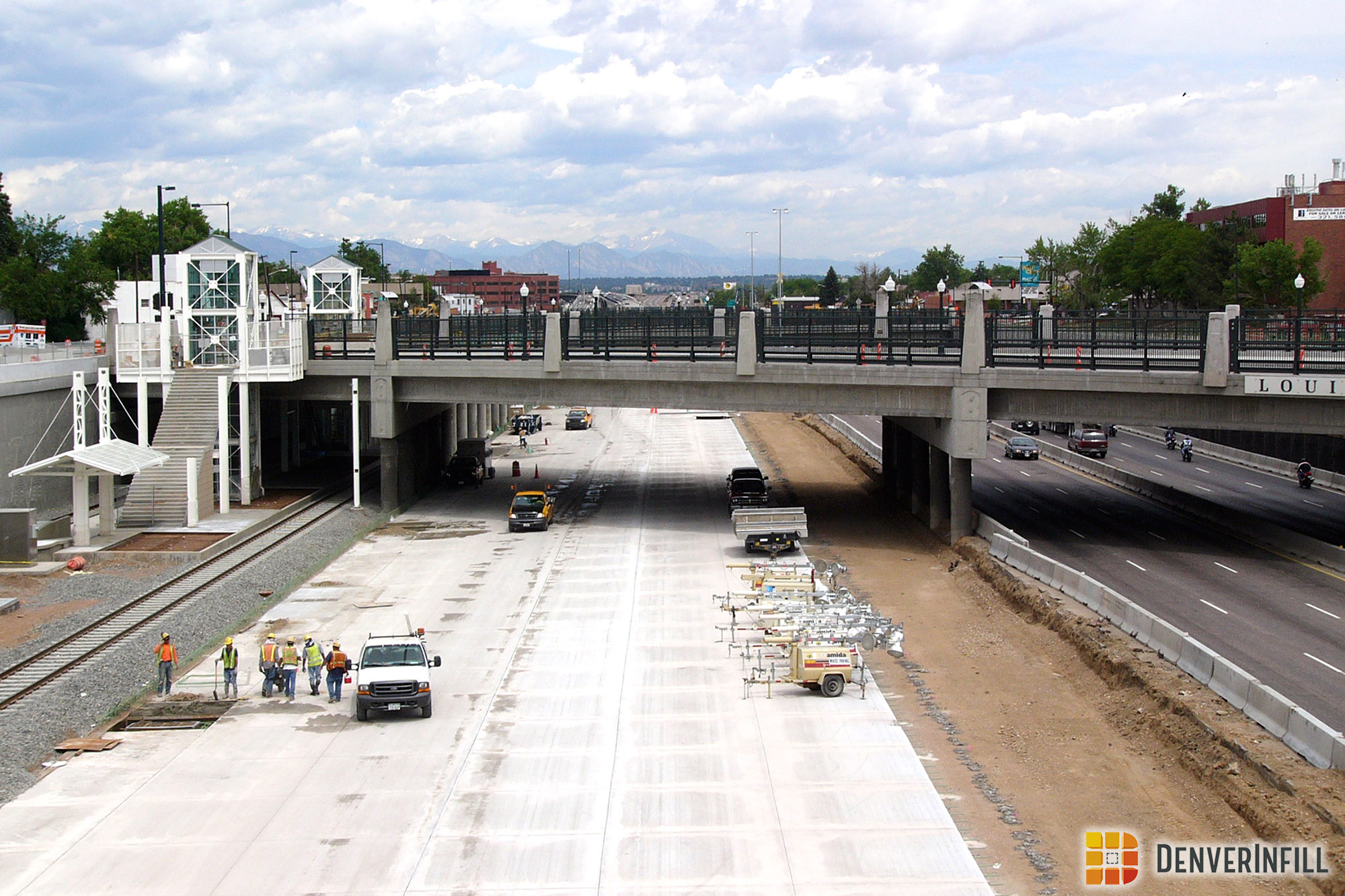
T-REX was the nickname given to the massive highway reconstruction/light rail project that was so successfully adopted by the public that even though the project has been finished for over three years now, people still refer to the southeast light rail line as the “T-REX line”. Construction on the 19-mile-long project began in 2002 and wrapped up four years later, with the grand opening ceremony taking place on November 17, 2006. The T-REX project rebuilt Interstate 25 from Broadway in Denver to Lincoln Avenue in Douglas County. Rebuilt, as in completely from the ground up, including new underground utilities, new storm water drainage, new roadbed, new bridges at every interchange, new sound walls, new lighting, new landscaping, and new signage. As part of the reconstruction, several new lanes were added in each direction, including braided on/off ramps and transition lanes at several interchanges to eliminate conflicts between vehicles merging on and off the highway. Interstate 225, from its interchange with I-25 to Parker Road in Aurora, also received a substantial reconstruction and widening. Along both I-25 and I-225, double-track light rail lines were laid with 13 stations along the way.

For those of you who are a friend of DenverInfill on Facebook, I’ve just uploaded two albums totaling 100 photos of T-REX construction and the grand opening. To become a DenverInfill Facebook friend, use the link on the right sidebar. Here’s a sampling:

T-REX construction 1 T-REX Construction 2

T-REX Construction 3 T-REX Construction 4

T-REX Opening 1 T-REX Opening 2

T-REX Opening 3 T-REX Opening 4

T-REX represents an excellent example of cooperation between CDOT and RTD, between Denver and its neighboring cities and counties, and a comprehensive multi-modal approach in making transportation investments.


#7: Downtown Denver Historic District

If pressed to name an historic district in Downtown Denver, I’d estimate that 98% of Denverites would cite Lower Downtown. In the 22 years since it was designated as an official Denver Historic District, LoDo has transcended from a seedy skid row of boarded-up buildings into one of the largest preserved Victorian-era commercial districts and coolest mixed-use neighborhoods in the country. Its fame is well-deserved. But less well known yet just as important is Downtown’s other historic district, the Downtown Denver Historic District, #7 in our countdown of Denver’s Top 10 Urbanism Achievements of the Aughts.

Unlike the Lower Downtown Historic District, which has relatively simple and straightforward boundaries, the Downtown Denver Historic District doesn’t really have any boundaries at all. The DDHD, designated by the city in 2000, consists of 43 buildings located on 18 different blocks throughout the Central Business District. About half of the DDHD’s buildings are also designated Denver Historic Landmark Structures, but the creation of the DDHD provides additional protection and control to ensure that these buildings will be around for a long, long time.

It is difficult to overemphasize the importance of the buildings in the DDHD to the integrity of Downtown Denver and to the soul of our city. Eleven of the buildings front the 16th Street Mall, and eleven more front 17th Street. These buildings are the core of Downtown. Their distinguished architecture, their impressive yet approachable scale, the craftsmanship and pride that went into them, gave credibility to a fledgling city back then, and give us today an understanding of our heritage as a city. Can you imagine Denver without the D&F Tower, the Brown Palace Hotel, or the Equitable Building? The fact that these buildings are scattered across a relative large area, from Tremont to Lawrence and 14th to 18th, means that you’re never more than a block or two from a building that serves as an historic anchor amid a sea of modernism and surface parking lots.

We lost a lot of great buildings during the second half of the 20th century, but the formation of the Downtown Denver Historic District in 2000 was a partial redemption and an important achievement in Denver’s evolving urbanism.


#8: Stapleton Redevelopment

Number 8 in Denver’s Top 10 Urbanism Achievements of the Aughts is the redevelopment of the former Stapleton International Airport. The decade began with the seven-square-mile site mostly “de-airported” and a master developer and detailed redevelopment plan in place. Construction of Stapleton’s first streets and homes started in 2001 and its first residents moved in during 2002. Over the course of the rest of the decade, it was full-steam ahead for the project, as Stapleton closed out the Aughts with over 3,000 homes, more than 8,000 residents, two major retail centers, offices, schools, hundreds of acres of parks… and it’s not even close to being built out yet.

Everyone has an opinion about the Stapleton development. For some, the lots are too small and the homes too close together and too pricey for their size—it’s just a little too urban. For many others, the project isn’t urban enough, with insufficient density and diversity for a project so close to the region’s urban core. On the urbanity spectrum, Stapleton falls somewhere between suburban and urban at a point that differs depending upon who you talk to and which aspect of the project you discuss.

Every time I go to Stapleton, I find myself intrigued, impressed, disappointed, amazed, conflicted. On one hand, I think the quality of the development—the streets, parks, plazas, bridges, and the buildings in general—is quite high, with a clear design intent and attention to detail that permeates the project. On the other hand, some of the neighborhoods give off a bit of a Truman Show vibe, and the residential architecture strikes me as perhaps more of a caricature of Denver’s historic neighborhoods than a modern interpretation of them. Yet, after spending a fair amount of time in Stapleton, I find its neighborhoods more interesting and appealing than just about any suburban development I’ve been to.

The heavy investment in park space has its pros and cons in my opinion. The parks are very well done and the natural areas along Westerly Creek are incredible. Central Park is a great public space and it will mature and be mentioned one day in the same breath as our city’s other great urban parks like City, Sloans, Washington, and Cheesman. However, there may be too much open space at Stapleton. One-third of the project’s land area is planned as parks and open space, which seems too high of a percentage to me, and that there’s some good urban land there that should be developed to capitalize on Stapleton’s central location.

Most disappointing are the commercial areas. The Stapleton master plan completely lacks any of the easy-to-walk-to, intimate, commercial corners tucked within a neighborhood like we have in our historic Denver districts. If Stapleton is supposed to be old Denver urbanism that’s new, then where is Stapleton’s Old South Gaylord, 32nd & Zuni, 11th & Ogden, or 12th & Elizabeth? The 29th Avenue Town Center is nice, but Quebec Square and Northfield are wasted opportunities. Both rely on the same big-box-power-center-that-could-be-anywhere-in-suburban-America design. Where is the mixed use? Where is the structured parking? Where are the apartments above the retail? At a minimum, Northfield and Quebec Square should have been a Belmar, but instead, we got an Aspen Grove.

One thing is certain, however, about the Stapleton project: it has been hugely popular and it has had a major impact on Denver’s growth and development. It has provided landlocked Denver with a type of development that it hasn’t had much of a chance to offer in many years. As the largest urban infill and New Urbanist project in the country, Denverites and urbanites across the country have watched Stapleton grow over the past decade and will continue to view it with interest as it matures, as Stapleton represents a notable experiment in how we build our cities in the new century.