
We’ve reviewed the light rail station, the underground bus terminal, and the commuter rail station. Now let’s take a look at the plans for Denver Union Station’s signature public spaces, starting with the 17th Street Gardens.
First, an overview of the proposed public spaces at DUS. The public realm within the Union Station transit district consists of a network of spaces that flows above, below, through, and around the various transit elements, the historic station, and the future private development buildings. We’ve discussed some of these already, such as the commuter rail Train Hall, Light Rail Plaza, the pedestrian concourse inside the underground bus terminal, the areas around the three pavilions, and the pedestrian bridge over the commuter rail tracks. The streets are also an important part of the public realm. Wynkoop, Wewatta, Chestnut, 16th, 17th, and 18th streets will all contribute in different ways to the character of the district. There’s also the inside of the historic station—perhaps the premier public space of them all—which we’ll discuss in a future blog post. Today, however, it’s about one of the two new signature public spaces at Union Station, 17th Street Gardens (Wynkoop Plaza is the other and next up in this series). The following graphic came from a presentation prepared back in the fall of 2008 early in the conceptual stage of the public space design, but it still does a good job of showing the basic framework for the public realm at Union Station and the different character zones within the district. As with all Union Station plan maps, west (northwest actually) is at the top, and east (towards downtown) is at the bottom:

The 17th Street Gardens is the main public space (aside from the rail platform areas) on the western side of the historic station. Labeled as the “linear gardens” on the map above, the short section west of Chestnut Street near the light rail station is now the Chestnut Pavilion Plaza and the short section east of Wewatta Street near the commuter rail station is now the Wewatta Pavilion Plaza. Both of these pavilion plazas will contain design elements from the 17th Street Gardens, but the main garden space is focused on the block in between Chestnut and Wewatta.
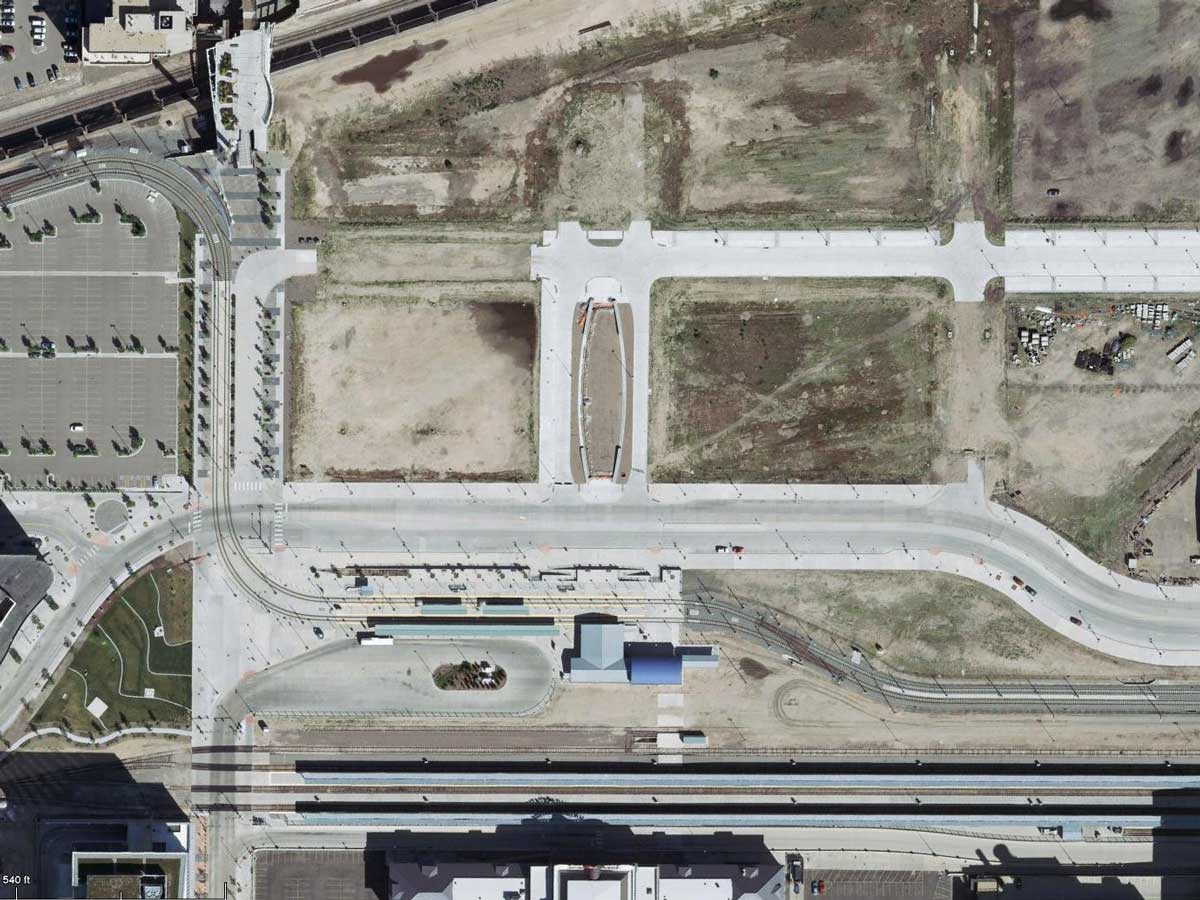
One of the earliest design changes recommended by SOM and Hargreaves (the transit and landscape architecture firms hired for the project) was to shift the 17th Street vehicle drive lanes to the south and eliminate the median. The original plan had a vehicle lane in each direction and a median centered within the wide 17th Street right-of-way. In fact, a few years ago this block of 17th Street was built (but never opened to traffic) and was removed only a few months ago when construction began:
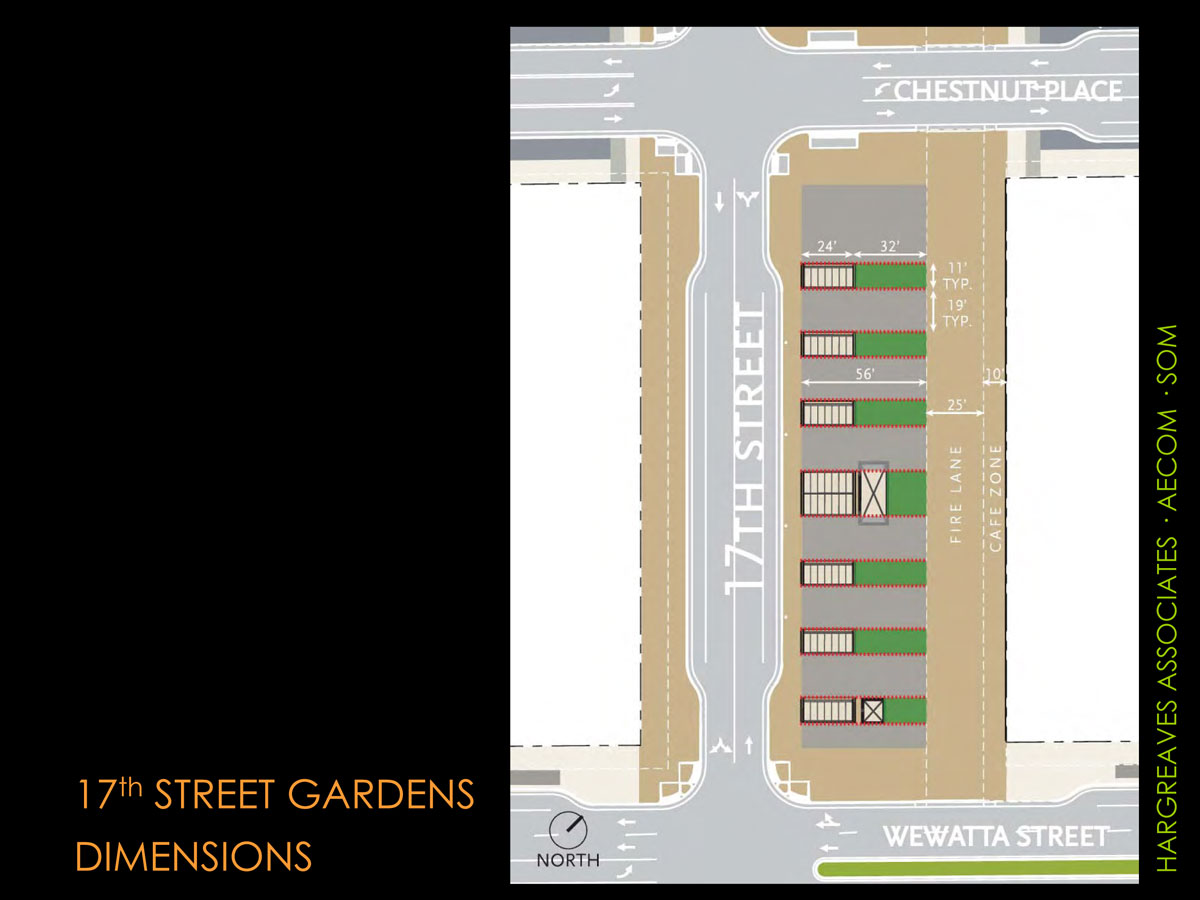
The new plan consolidates the public space by shifting most of the plaza to the north (sunny) side of 17th Street. Centered within the right-of-way are the skylights that provide light to the bus terminal below. Extending horizontally across the plaza from each skylight are raised planting beds with seat walls. These create the framework for the eight “rooms” that will feature different landscape and urban design elements. A 25-foot wide fire lane provides the main pedestrian walk zone, ending with a 10-foot wide zone for restaurant patio seating. Between the skylights and the street is an 8-foot sidewalk, and the south side of the street still enjoys a wide sidewalk and a cafe seating zone:
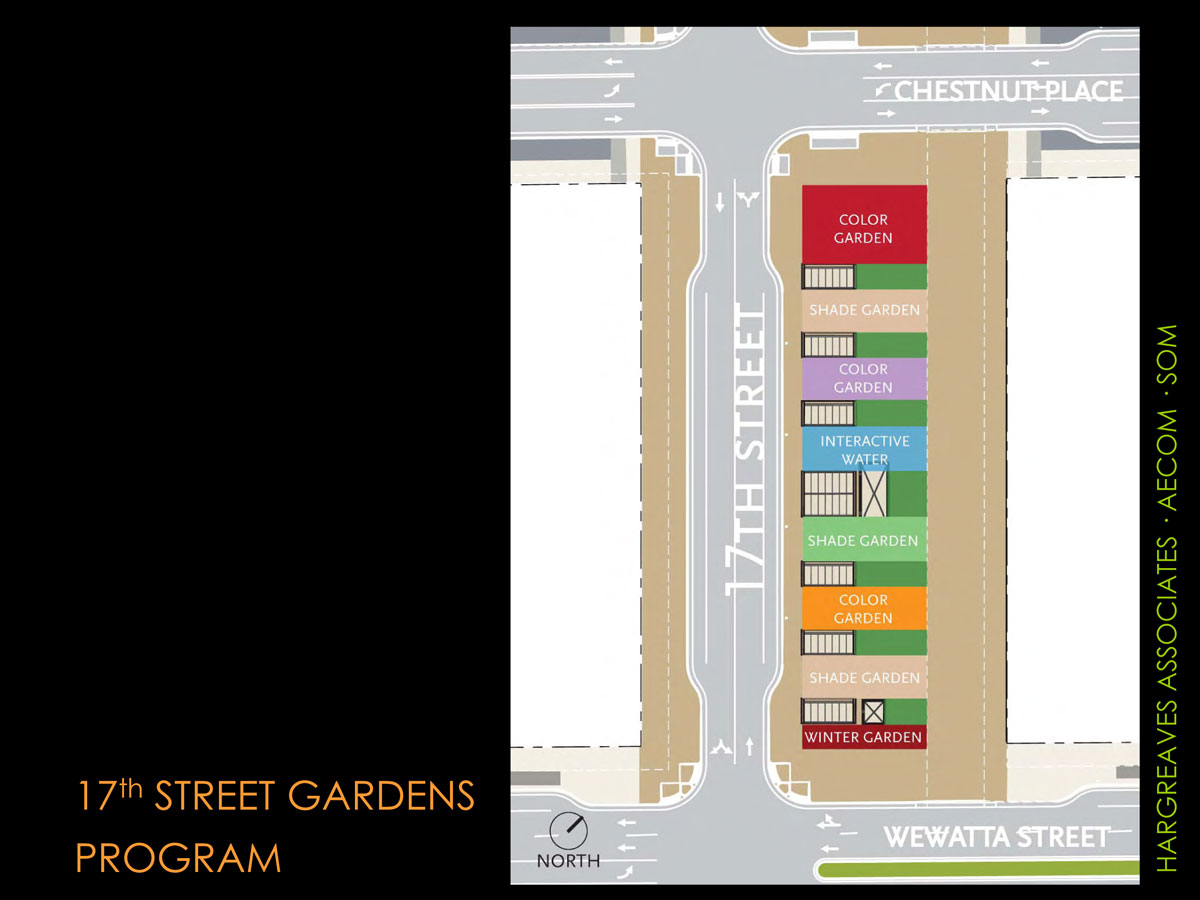
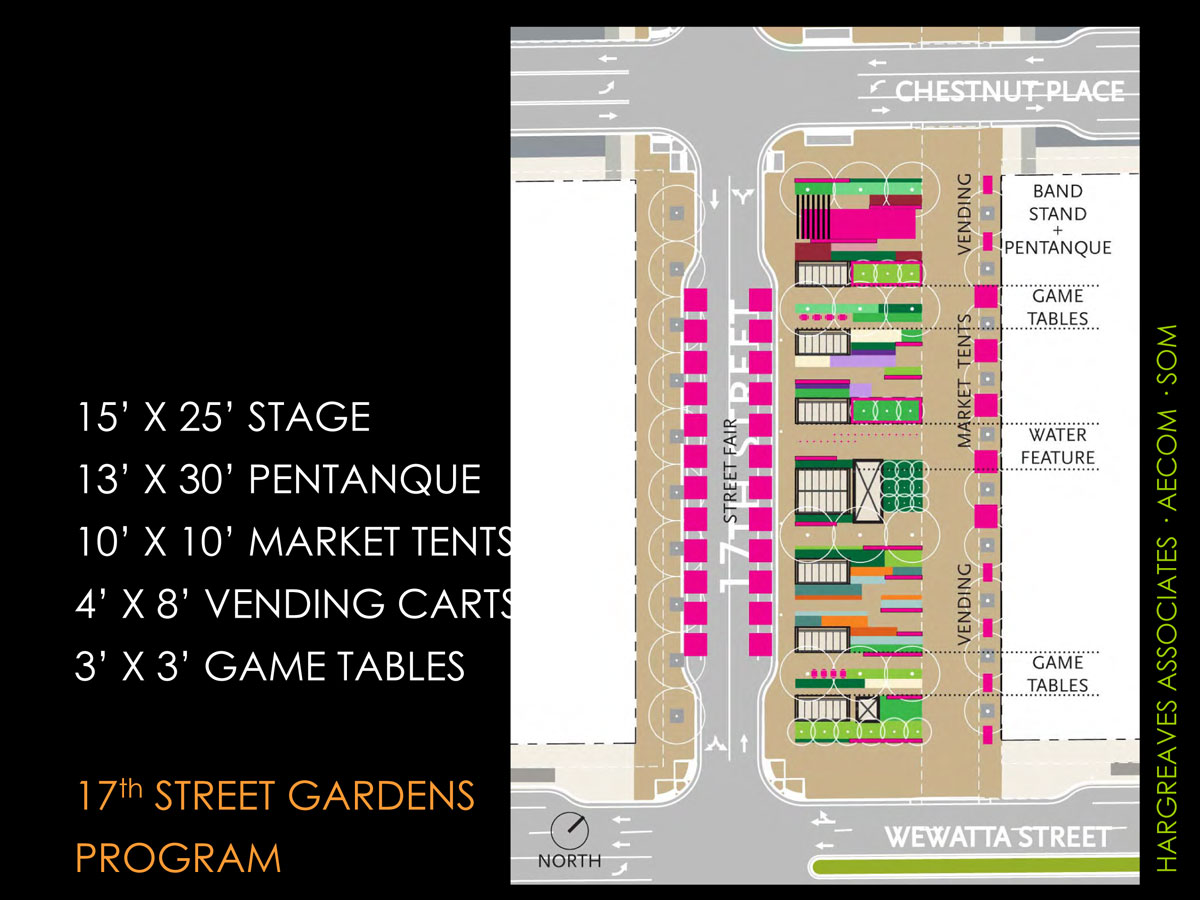
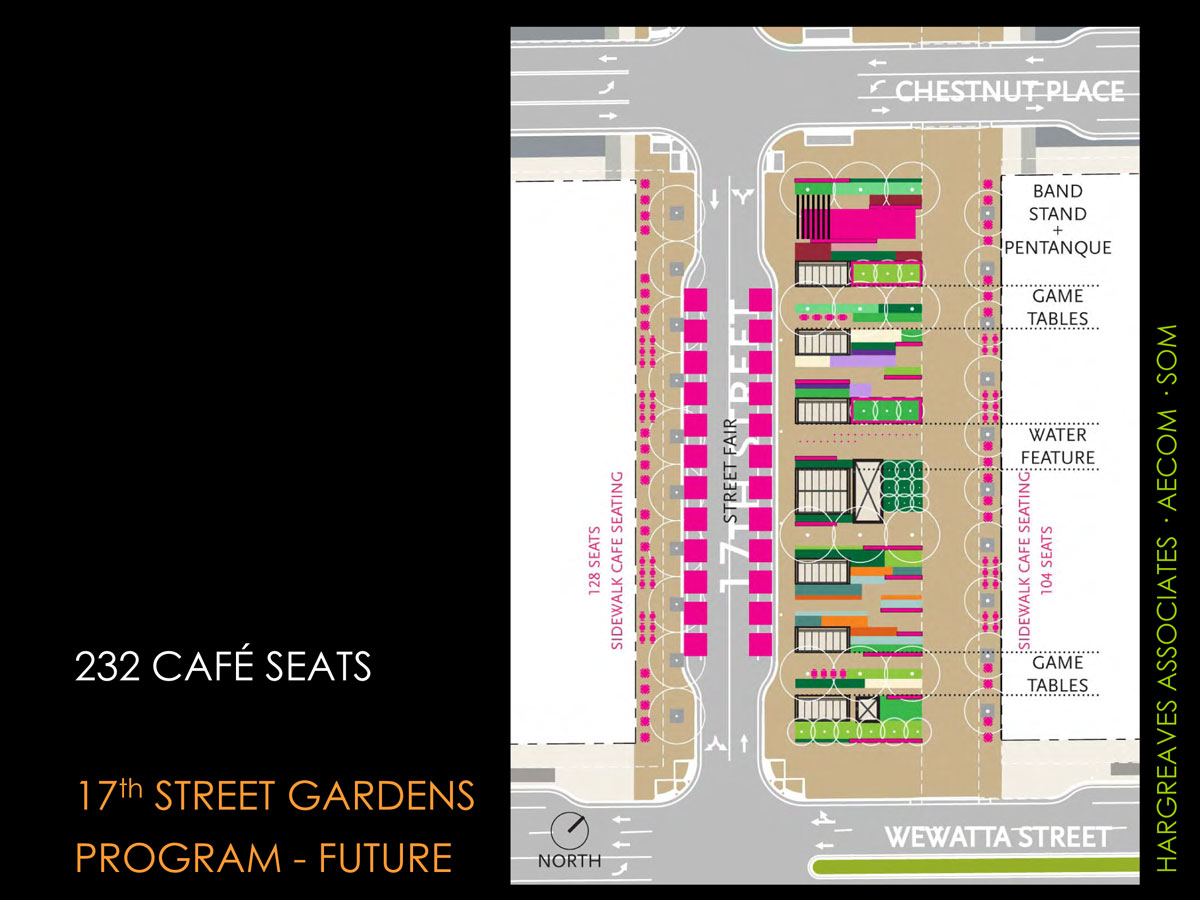
A key aspect of a successful public space is a design that people feel comfortable hanging out in, yet also allows for a variety of programmed events to occur, such as stage performances, street fairs, games, vending carts, etc. The 17th Street Gardens layout provides that flexibility between programmed and passive use. For larger events, 17th Street can be closed down, providing even more space. Here are two images that show the variety of programmed uses that could be incorporated in different combinations throughout the seasons:
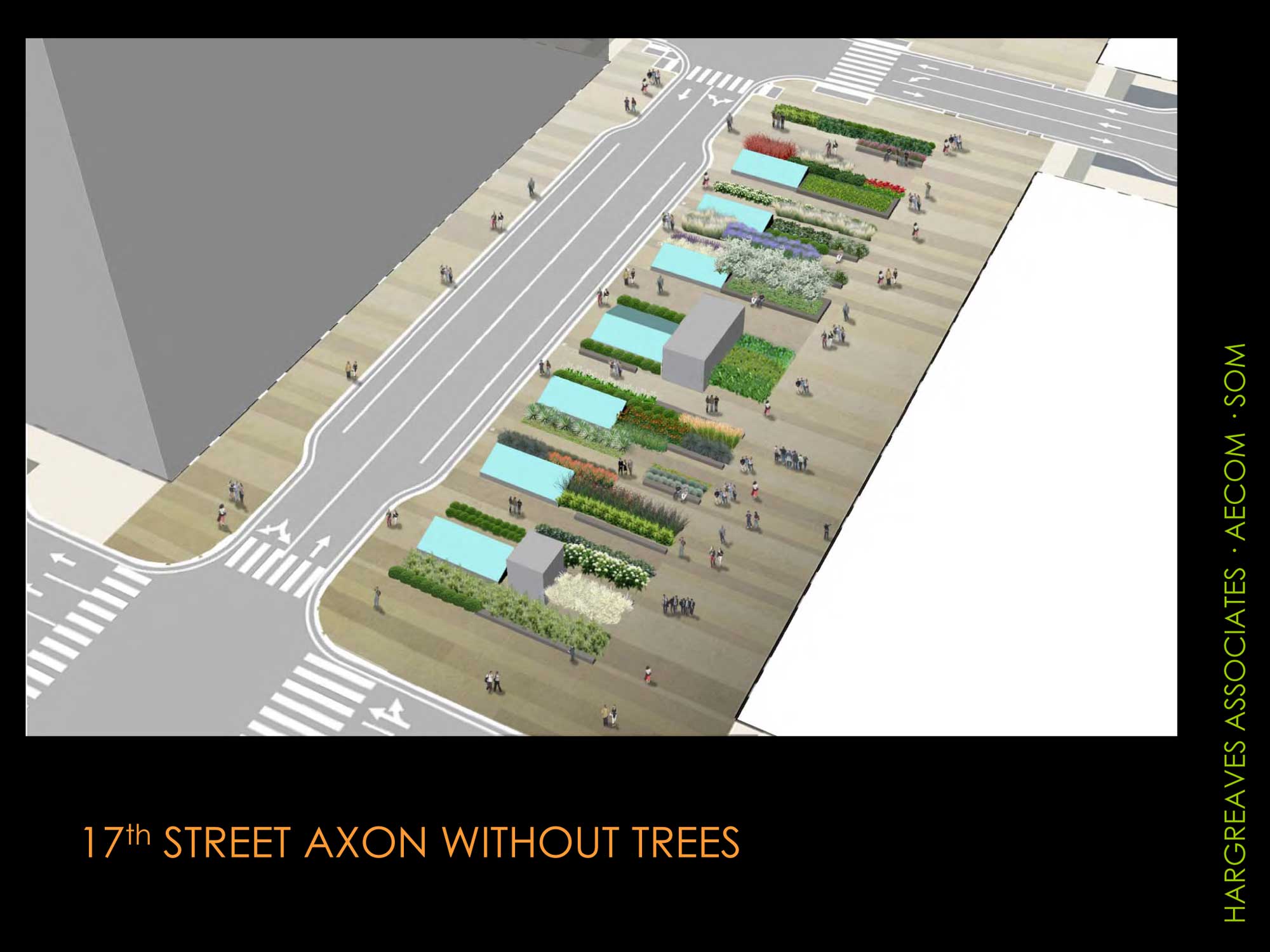
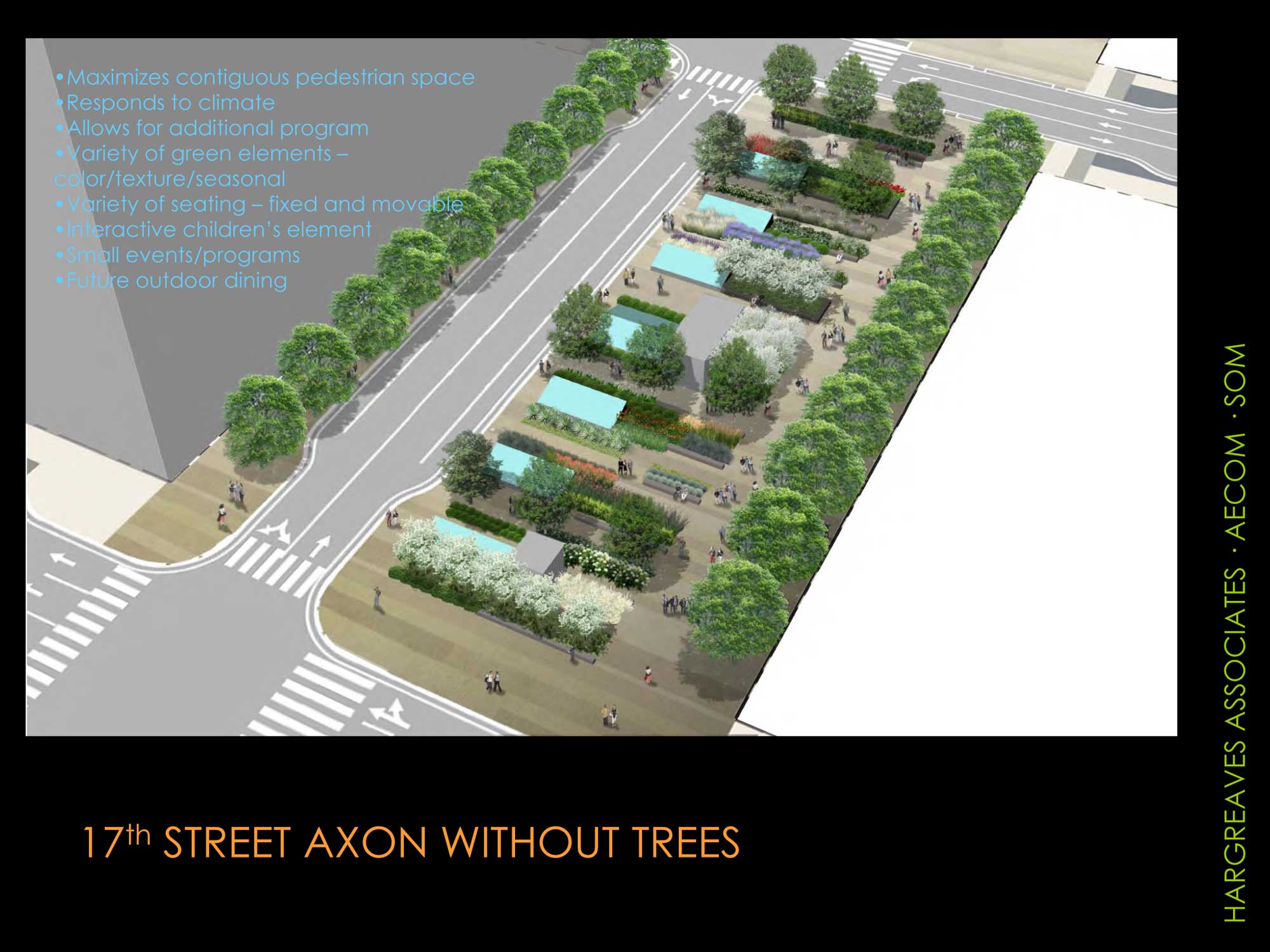
The landscape plan for the gardens is intended to provide a variety of interesting plant colors and textures for all four Colorado seasons:
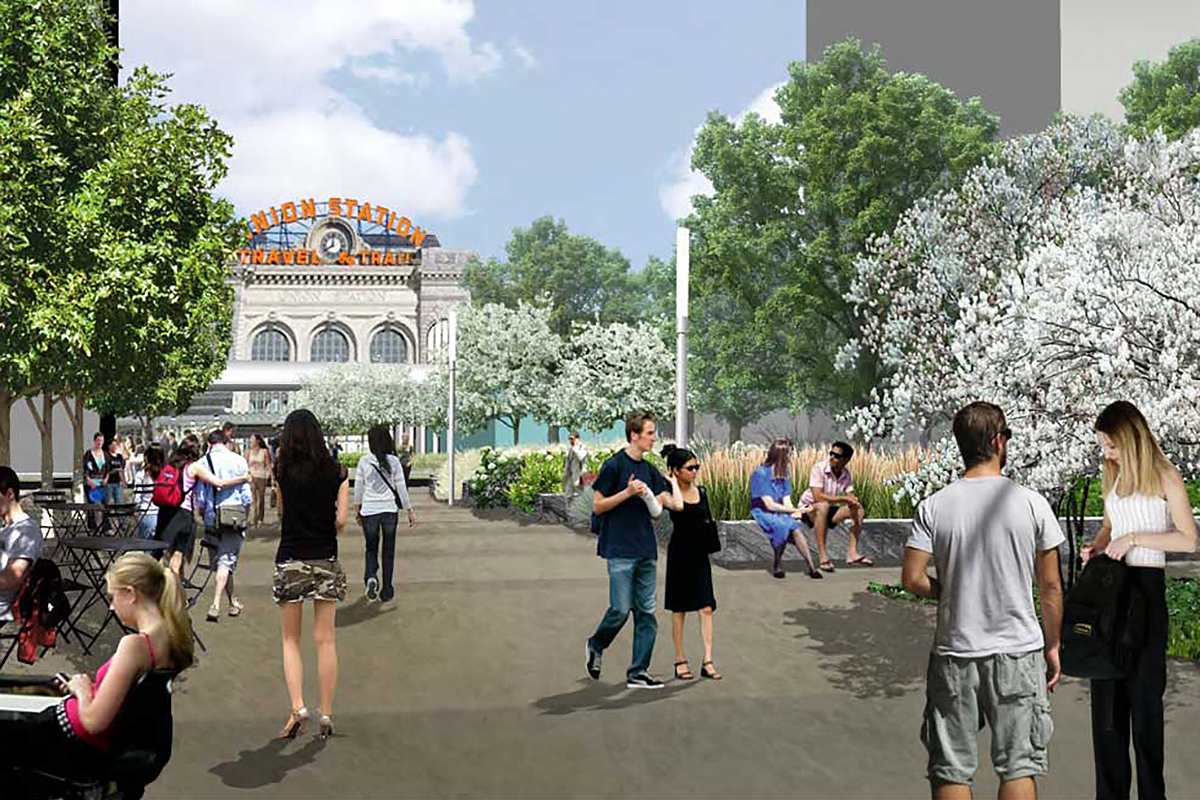
Finally, here are some street-level renderings of the finished 17th Street Gardens:
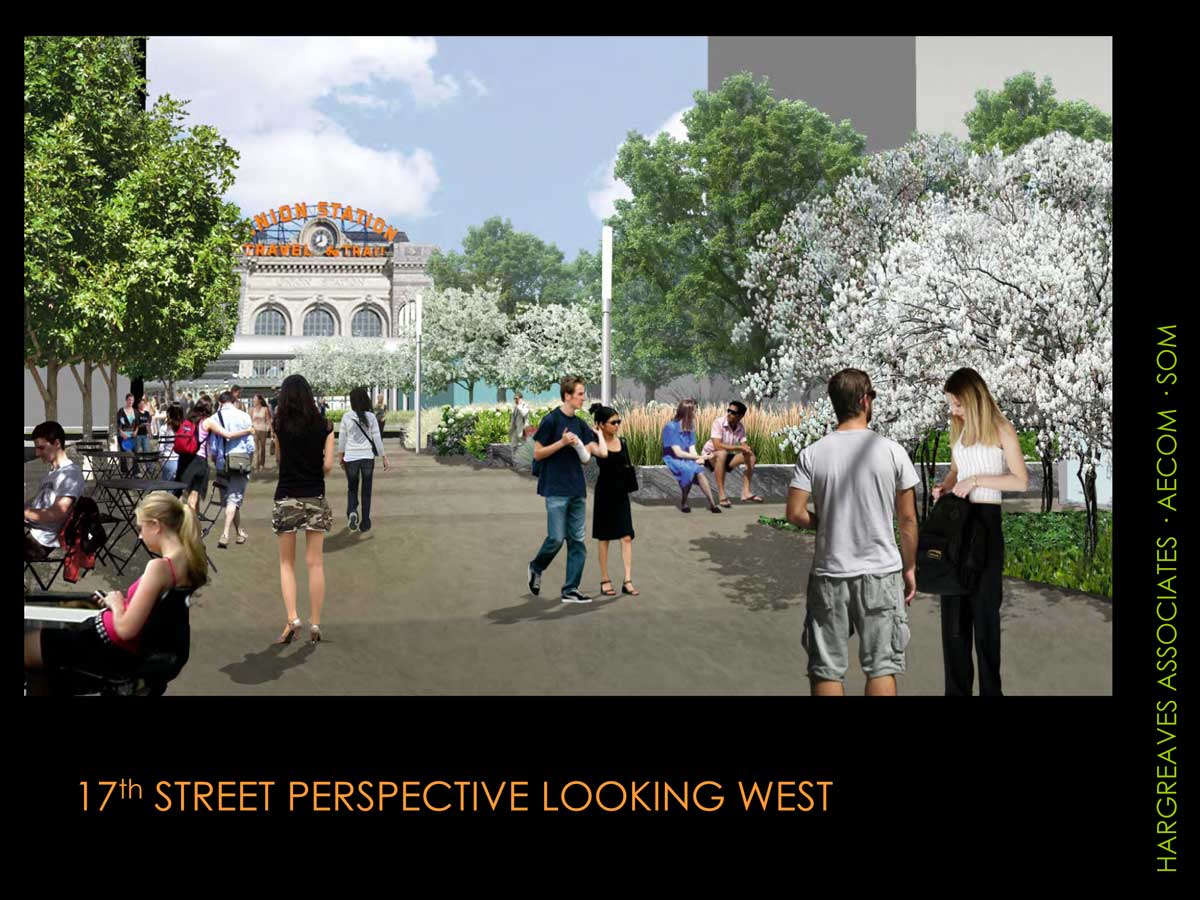
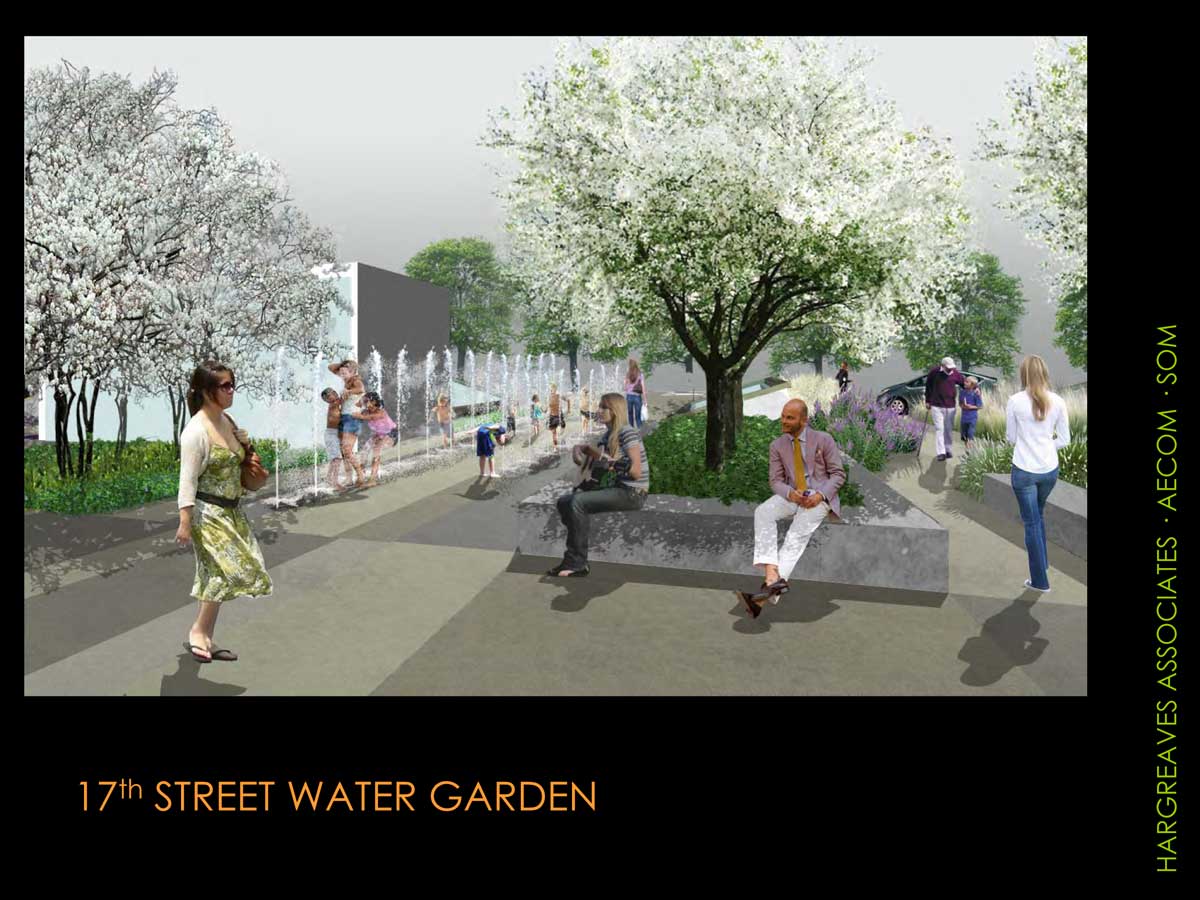
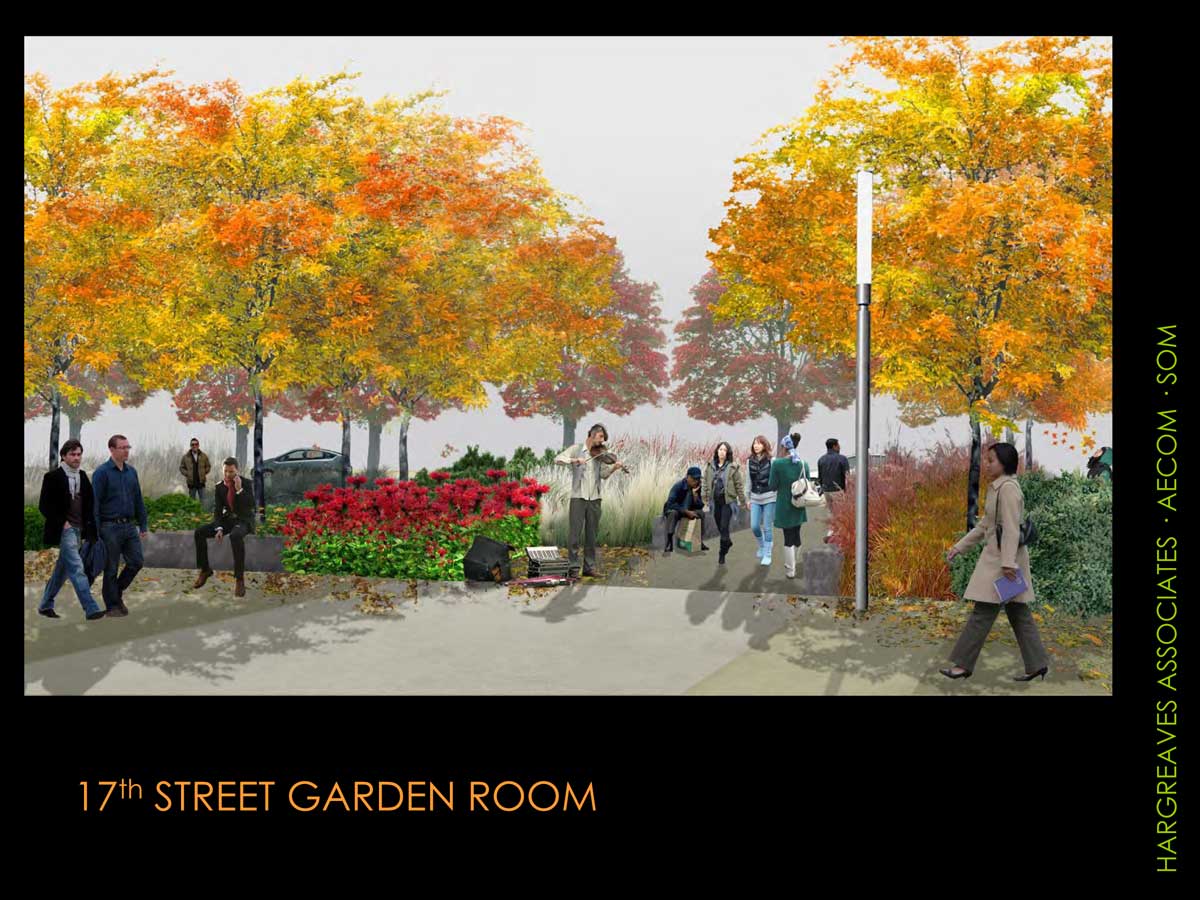
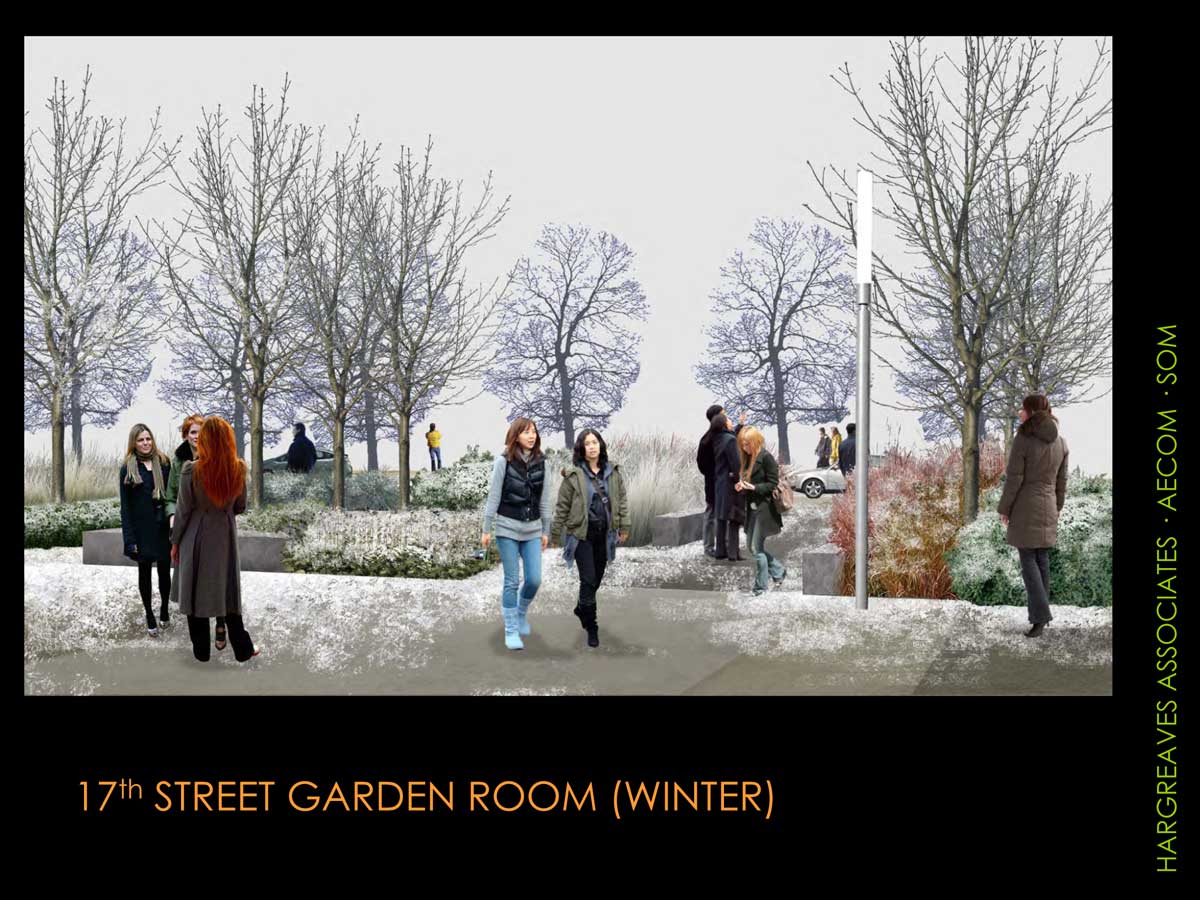
Of course, until both buildings along 17th Street facing the gardens are completed, the 17th Street Gardens won’t “feel” finished, as it is the sense of enclosure that buildings provide that is such a critical component to a successful urban space. Let’s hope for a speedy economic recovery so the private sector developments within and adjacent to the Union Station transit district can be built to complement this significant public infrastructure investment.


Looks great! Hey what is going to become off all the mizpah arch?
Imagining the Seventeenth Street gardens built with no buildings around them reminds me of when Skyline Park was first built. Although the section between Fifteenth and Sixteenth was finished at about the same time as the Park Central building next to it, it took a lot longer to get Tabor Center and “Energy Plaza” (I forget what it’s called now–the aluminum tower at Seventeenth and Lawrence with the Chase Bank) built, and those two blocks of Skyline Park were all by their lonesome for several years.
What sort of traffic will be driving down this section? Is is open to cars, are there going to be a lot of stinky diesel busses driving by? I guess I like the idea of it not even being open to vehicles. I would love it if it was only pedestrian and bike traffic. Are those parking lanes on either side of the road?
Trevor, there shouldn’t be any buses on this block of 17th. Just local access to the building to the south (although not to their underground parking which should be off of Wewatta or Chestnut. Yes, on-street parking on both sides, which will further keep it a very slow, local street.
Are those really going to parking spaces? Seems like a really obvious location for short-term kiss-n-ride – pick up and drop off.