Skip to content
Archive of posts filed under the Adaptive Reuse category.

Denver Union Station Reuse Options?

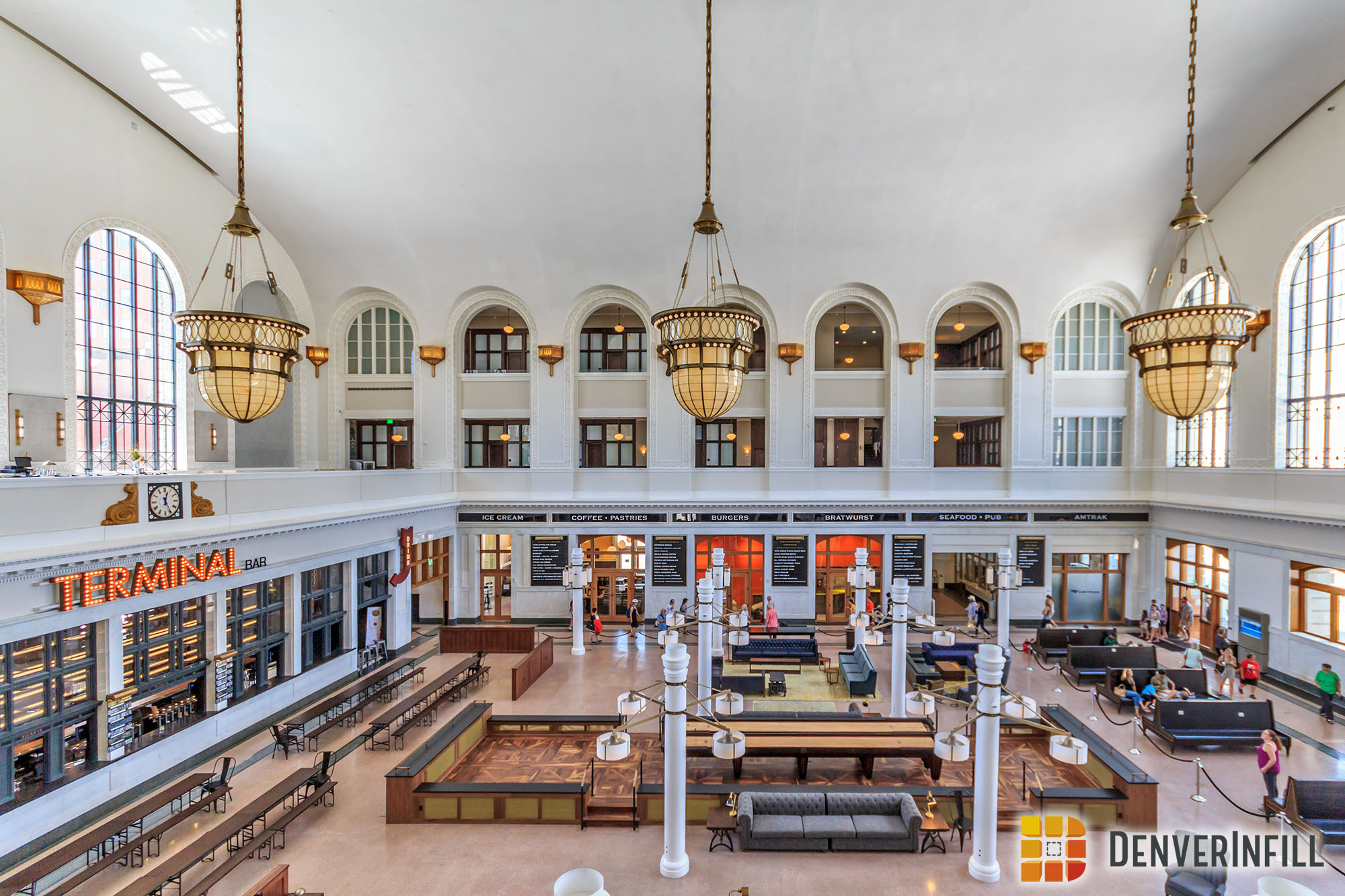
Over at DenverUrbanism, we’ve just uploaded a special feature taking a look at two proposals that have been recently announced for the reuse of the historic Denver Union Station building. As you know, construction is in full swing on the RTD transit elements at Union Station. Now it’s time to focus in on the renovation and reuse of the historic station.

Start with this introduction post on the topic, followed by this post about Union Station Neighborhood Company’s idea for a public market, and this post about a group led by Dana Crawford that want to bring a boutique hotel to Union Station. Read all about it (and comment on it) over at DenverUrbanism!


Colorado National Bank Hotel Conversion Underway

I recently had the opportunity to view the interior of the historic Colorado National Bank building that has sat vacant at the corner of 17th and Champa for about four years. As you may recall from a DenverInfill blog post from December 2009, the building will be renovated and expanded to become a new botique hotel. Here’s a bit more about the project:

The owner/developer is Stonebridge, a Denver-based hospitality development firm, which recently completed the Hilton Garden Inn at 14th and Welton, and the project architect is JG Johnson Architects, which specializes in hospitality design. The plan is to add two floors to the top of the building (set back from the existing roof line), renovate/restore the existing six-story structure, and add a new stairwell and entryway on the building’s southwest side that faces a small surface parking lot. That surface lot is also owned by Stonebridge, so it will be used for a new glass porte-cochère and a few spaces for short-term guest check-in parking. All other parking for the hotel will be provided as a valet service to leased spaces off site. The main pedestrian entrance faces 17th Street and features the bank’s grand metal doors.

Here are a couple of images, courtesy of JG Johnson Architects, showing the proposed addition:

2011-01-17_cnb1 2011-01-17_cnb2

As the first image shows, the shape of the addition is like a square donut, with the hole serving as a light well for rooms that will face the interior. For this reason, a hole will be cut into the center of the top three floors of the existing building so that light can penetrate down through all but the first three floors.

The facade design and materials of the addition have not been finalized, but as these concept images above show, the addition will clearly reflect a contemporary design and feature a contrasting dark color to the historic building’s white facade.

A few other facts about the building: It will have 230 rooms, banquet/meeting rooms in the basement (including one inside the bank’s vault), a ground-floor restaurant and retail space, and a lounge in the mezzanine overlooking the lobby. The hotel is planned to be branded a Marriott Renaissance, a Marriott brand not yet found in Denver but one that often features hotels in historic or converted buildings (thus, the name “renaissance”). Currently, some remediation and interior demolition work is taking place. In May or June, the curb lane of Champa next to the building will be closed down and a crane positioned there to begin actual construction of the addition and major renovation work. If all goes as planned, the hotel will open in Fall 2012.

One other note about this building: it is absolutely beautiful inside and, once finished, in my opinion, it will become one of Denver’s swankiest and hippest hotels. The lobby is spectacular, and features a three-story atrium with classical marble colonnades and 16 large murals by famed artist Allen Tupper True. The murals will be protected during the restoration and will remain as one of the building’s prominent features.

Here are a few photos of the lobby I took several months ago before interior work began. I was using my phone camera and no flash so the quality isn’t the greatest:

2011-01-17_cnb3 2011-01-17_cnb4

The building is on the National Register of Historic Places and is a member of the Downtown Denver Historic District. The project team has already received all of their approvals from the Denver Landmark Preservation Commission and also has its financing in place. So, it’s full steam ahead for the transformation of this historic landmark on 17th Street into a new four-star hotel!


Re-Envisioning the Denver Coliseum

DenverInfill had the privilege to partner this year with NAIOP-Colorado to promote the Rocky Mountain Real Estate Challenge, the annual high-profile competition between the real estate programs at the University of Colorado and the University of Denver. This year’s challenge, as discussed in my post of April 20, involved a re-envisioning of the Denver Coliseum property near I-70 and Brighton Boulevard in the Elyria-Swansea neighborhood.

The challenge focused on a 46-acre site that included the Coliseum and its parking lots to the southwest toward Globeville Landing Park. The site sits at the crossroads of the redeveloping area north of Downtown that features nearby the RiNo arts district, future FasTracks transit stations, South Platte River amenities, and excellent highway access. One of the competition’s main assumptions was that the Coliseum had to remain the property of the city and continue as an entertainment venue. For all of the program’s rules and requirements, review the document included with the April 20 post.

Last night, over 600 people packed the ballroom at the Downtown Marriott to hear the two teams’ presentations and the selection of the winner. The result: the University of Colorado was victorious and snapped a four-year DU winning streak. Congratulations CU!  Both teams, however, put forth excellent presentations that offered innovative, yet different potential futures for the Coliseum area. I’m happy that DenverInfill is able to present both teams’ proposals from last night.

CU envisioned the site as the Denver Center for Creating Art, with the Coliseum reconfigured as a performance and rehearsal venue and new development providing space for the Art Institute of Colorado and other arts-related businesses. Below is CU’s proposed site plan and here are links to PDFs of CU’s executive summary (1.6 MB) and full presentation (14.7 MB).

2010 RMREC - CU Team Site Plan

DU, on the other hand, envisioned the site as the Frontier Center at the Denver Coliseum, a complex focused on “agri-tech” and alternative energy education and business development, with a conference center and incubator space for entrepreneurial businesses focused on these evolving industries. A site plan from the DU presentation is below, and here are links to PDFs of DU’s executive summary (0.6 MB) and full presentation (6.1 MB).

2010 RMREC - DU Team Site Plan

While both plans represent academic exercises only and do not necessarily reflect what will eventually be planned for the Coliseum, the potential for the site as described by both teams is exciting and gives Denver citizens and its leaders plenty to consider as the Coliseum area transforms into a vibrant extension of our urban core. Congratulations to the students from both schools, and many thanks to everyone at NAIOP and the City involved in organizing this year’s Rocky Mountain Real Estate Challenge and for their efforts to enhance the quality of both universities’ real estate programs and to promote excellence in Denver’s urban environment.


Saddlery Building Renovation Update

Last fall I mentioned that the Saddlery Building at 15th and Wynkoop was finally getting its long-overdue makeover, and how amazing the exterior is looking after a good scrubbing. Today I’m happy to provide additional details about the historic structure’s rehabilitation, thanks to Kevin and Nancy from Studio K2 Architecture.

Work continues on the brick facade restoration, with only the 15th Street side remaining to be cleaned. Also of note has been the work on the windows. Many of the windows, particularly the large ones at street level, had been bricked in years ago. Now, the brick has been removed and, while the new windows are not yet in place, it is exciting to see the building’s steady transformation.

The completed project will include retail/restaurant space on the ground floor, office space on Floors 2 through 5, and the addition of two copper-clad residential penthouses at the top. The images below are courtesy of Studio K2 Architecture:

Here’s a perspective of the entire building as viewed from the roof of the Steelbridge Lofts across the intersection:

2010-02-18_saddlery2

and the Wynkoop side from ground level:

2010-02-18_saddlery1

and the project site plan:

2010-02-18_saddlery3

You’ll notice in both images that a new wide sidewalk will be installed in front of the building along Wynkoop Street. Since the building’s construction in 1900, there’s never been a sidewalk along the Wynkoop side of the building given the loading dock’s location there. Speaking of the loading dock, the existing dock will be removed and a new, wider dock will be added that will not only allow for ADA access to the building, but will provide sufficient room for other uses, such as a restaurant patio. While the diagonal parking and narrow sidewalk located in front of the surface parking lot to the north along Wynkoop will continue to inhibit pedestrian movement, the new wide sidewalk in front of the Saddlery will be a huge improvement to the Lower Downtown streetscape.

The Saddlery Building project will be complete later this year.